
When five-year-old David Osagie arrived at a public primary school in Benin City with his mother for enrolment last September, she carried what she believed was every document her son would ever need.
His birth certificate had been issued shortly after birth by the National Population Commission (NPC).
It bore a Quick Response (QR) code and existed in the commission’s central digital database.
She assumed the school would simply verify the record electronically.
Instead, the head teacher glanced at the certificate, accepted the date of birth as presented and completed the admission manually.
No QR code was scanned. No digital record was queried. No government database was consulted.
By the time David walked into his classroom, his officially registered birth had effectively become another paper document in a school file.
The promise that one verified identity could follow a Nigerian child from birth into education had broken at the school gate.
David’s experience reflects a wider disconnect uncovered by the News Agency of Nigeria (NAN) in Edo and Oyo states, where government agencies have made major progress in digitising birth registration and expanding the National Identification Number (NIN).
Yet, schools continue to rely largely on manual admission processes that cannot communicate with identity databases.
The investigation comes at a time when Nigeria is expanding digital identity services.
UNICEF says birth registration is fundamental to a child’s legal identity and access to education, while recent efforts by the National Population Commission and its partners have enabled more than 10 million children to obtain birth registration through electronic systems.
Notwithstanding these gains, experts say the inability of government databases to communicate across sectors continues to undermine efficient service delivery.
The findings expose one of the weakest links in Nigeria’s Digital Public Infrastructure (DPI) agenda.
While citizen records are currently being digitised, they remain fragmented across institutions, forcing parents to repeatedly present the same birth certificates and identity documents throughout their children’s educational journey.
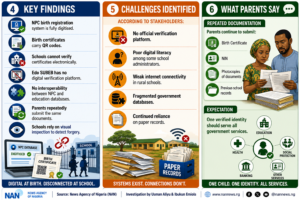
The Edo State Universal Basic Education Board (SUBEB) confirmed that admission into public primary and junior secondary schools remains entirely manual.
Mrs Ebanehita Omonzane, Executive Chairman of the board, said parents seeking admission were required to submit admission forms alongside birth certificates, passport photographs, parents’ identification documents and previous school records where applicable.
However, in spite of collecting birth certificates, schools have no electronic means of determining whether the documents presented are genuine.
“There is no digitalised system for verifying pupils’ birth certificates or birth registration within the Edo SUBEB ecosystem,” she said.
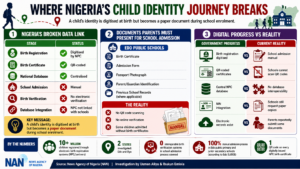
Omonzane attributed the situation to the absence of an official verification platform, poor digital literacy among some school administrators and weak internet connectivity across many rural schools.
She added that some parents still enrolled children without presenting birth certificates, relying instead on declared dates of birth.
More significantly, she disclosed that the board had neither ongoing plans nor future initiatives to establish interoperability between education and identity management systems.
The Edo Ministry of Education painted a similar picture.
Mrs Mercy Isibor, a Deputy Director in the ministry, said admission into both primary and secondary schools remained entirely manual, with applicants simply submitting photocopies of birth certificates alongside admission forms.
“There is no interoperable way of verifying birth for now in the state,” she said.
The findings sharply contrast with the digital transformation taking place within the National Population Commission.
The Federal Commissioner representing Edo at the NPC, Dr Tony Aiyejina, said the commission’s birth registration system had become fully digitised.
“NPC is fully digitised. We have a centralised national database where all registration data are stored,” he said.
According to him, birth certificates issued by the commission carry QR codes that can be used to verify authenticity.
However, he acknowledged that the commission’s database was not connected to education platforms operating within Edo.
“NPC birth registration database is not connected to any educational platform within Edo State,” he said.
The implication is that although government has digitised birth registration, schools still lack the infrastructure to retrieve or authenticate records electronically during admission.
The situation is not different in Oyo State.
Parents interviewed by NAN said they repeatedly submitted the same identity documents in spite of government agencies already having the information.
Mr Kunmi Adepoju said that although his child obtained a birth certificate shortly after birth, he had continued to present the same document at different stages of the child’s education.
He recalled that the birth certificate was issued through the hospital after delivery, while the child’s NIN was obtained much later.
According to him, the birth certificate was again required during school enrolment together with other documents already supplied to government institutions.
“We seek a more robust database that would eliminate duplication. Everywhere you go, you present your certificates and make photocopies because that’s the system we are used to,” he said.
Another parent, Mr Siyanbola Adegoke, expressed hope that government agencies would eventually adopt interoperable identity systems capable of eliminating repeated documentation.
“We wish for a better system where things flow seamlessly and government agencies can access the information they already have instead of asking us to present the same documents every time,” he said.
Their experiences are reflected within schools.
Mrs Ibitayo Olutayo, a counsellor and enrolment officer in a public secondary school in Oyo State, said student enrolment still relied largely on paper records with little integration of digital identity systems.
She explained that while public schools generally required fewer documents than private schools, student files often contained only basic information such as previous academic results and passport photographs, making records incomplete and difficult to retrieve.
According to her, the absence of a centralised digital record system means schools and government agencies repeatedly request the same documents from parents, students and even teachers.
She argued that securely storing verified information would simplify school administration and examination registration while reducing unnecessary stress on families.
Private schools face similar challenges.
The National Secretary of the National Association of Proprietors of Private Schools (NAPPS), Dr Kayode Adeyemi, said admission officers currently had no access to any central database for verifying birth certificates or other admission documents.
“We actually do not verify. Once you are not seeing any forgery or tampering, you take it like that because we don’t have a central record where schools can check,” he said.
Adeyemi said schools occasionally encountered attempts by parents to manipulate children’s ages, especially during admission into junior secondary school.
He explained that schools normally required birth certificates, medical records and transfer documents, but some parents claimed they had relocated and could not produce the necessary records.
“If there is a place schools can check the authenticity of documents or scan a code digitally, it would be helpful,” he said.
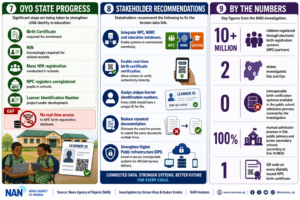
He disclosed that Oyo State, in collaboration with the Federal Ministry of Education and development partners, was working on a learner identification system that would assign every child a unique learner identification number.
According to him, the initiative would enable schools to access pupils’ educational history during transfers, reducing duplication and strengthening record integrity.
He, however, noted that the project was still under development.
The Oyo State Government says it has nevertheless made considerable progress in integrating digital identity into education.
Mrs Oyinloye Bamidele, Permanent Secretary, Oyo State Ministry of Education, said birth certificates and NIN had become central requirements for school enrolment while pupils’ records were continuously being digitised.
She explained that pupils without NIN were not denied admission but were expected to obtain one before reaching terminal classes where it became mandatory for national examinations.
Bamidele said one of the greatest challenges remained parents’ inability to provide birth certificates because many births were either never registered or the documents were unavailable.
To address this, she said the ministry collaborated with the National Identity Management Commission (NIMC) to conduct mass registration exercises in schools with large numbers of unregistered pupils.
She added that access to education databases was restricted to authorised institutions to ensure data privacy and protection.
The NPC says it has equally strengthened efforts to improve birth registration before children enter school.
Mrs Olubisi Adegbite, Oyo State Director of the commission, said officials regularly visited schools, engaged Parent-Teacher Associations and registered pupils who had missed birth registration.
“We don’t want the time that the child needs the certificate before parents begin to rush us. That is why we are going to schools and registering the children,” she said.
Adegbite disclosed that birth registration had now been integrated with the NIN system, enabling newly registered children to obtain NIN automatically, although occasional connectivity challenges still occurred.
She added that each birth certificate carried a unique identification number that allowed records to be retrieved electronically.
However, schools still lacked direct real-time access to the commission’s database.
Similarly, an official of NIMC in Oyo State said the commission had expanded registration through ward-based enrolment, mobile registration teams and accredited agents to improve access for residents, including school-age children.
“We’ve been doing what we call ward enrolment since February.
“The essence is to bring enrolment of NIN closer to the people,” the official said.
The official explained that children seeking NIN must present government-issued birth certificates before enrolment.
Stakeholders believe the missing link is no longer data collection but data integration.
The Secretary of the Nigerian Union of Teachers (NUT), Oyo State Wing, Mr Salami Olukayode, said government agencies must harmonise identity databases to eliminate repeated requests for the same documents.
“If our data are properly captured and linked from one government agency to another, there will be less need to keep requesting the same information from citizens,” he said.
According to him, Nigeria’s challenge lies not in generating data but in managing and harmonising it across relevant institutions.
The investigation indicates that while Nigeria has made measurable progress in digitising birth registration, expanding NIN enrolment and introducing electronic education records, these systems continue to operate largely in isolation.
For parents, the consequence is repeated documentation. For schools, it is inefficient record management.
For government, it is the inability to fully harness the benefits of Digital Public Infrastructure for planning and service delivery.
Until birth registration, national identity and education databases can communicate seamlessly, thousands of Nigerian children will continue to carry paper records from one classroom to another, even though their identities already exist in government databases. (NANFeatures)
***If used, please credit the writer and the News Agency of Nigeria.
“This report is produced under the DPI Africa Journalism Fellowship Programme of the Media Foundation for West Africa and Co-Develop.”