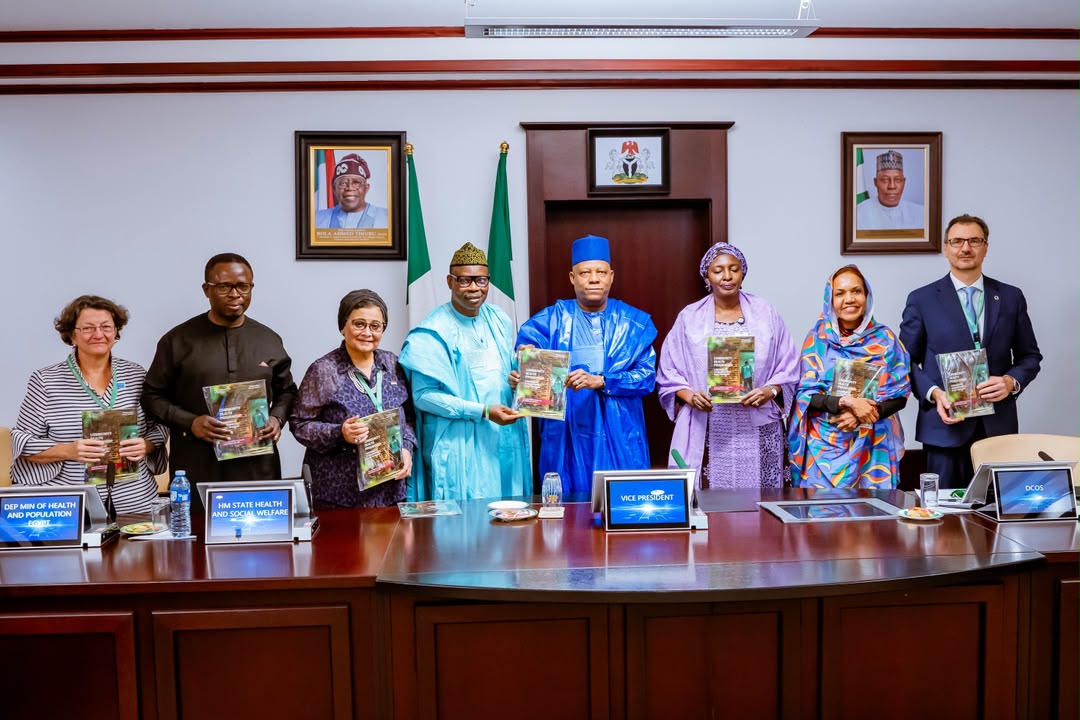
Vice President Kashim Shettima has restated the determination of President Bola Tinubu’s administration to improve the welfare, guaranteed rights, and salary reliability of community healthcare workers.
Shettima gave the assurance on Thursday in Abuja during the inauguration of the Community Health Programme Continental Acceleration Plan 2026–2030 at the Continental High-Level Forum on a Fit-for-Purpose Health Workforce.
He maintained that fair, competitive, and consistent remuneration for medical personnel was vital to building robust community health services and institutions across Nigeria.
“If you look around today, if you look across Africa, the number of community health workers is increasing. But we cannot deliver on this promise unless we acknowledge the threats that surround us.
“Our Community Health Programme Continental Acceleration Plan focuses on governance, primary care integration, workforce development, digital systems, service delivery, financing, supplies and accountability as drivers of our future.
“A future where workers are guaranteed legal recognition, certification, dependable salaries, supervision and careers,” he declared.
Shettima said that the distance between a household and a health worker could become the distance between survival and mourning.
He, however, said that it was the duty of the government to shorten that distance until no African’s chance of living depends on the accident of where they were born.
He noted that Tinubu has been a pacesetter in financing health reform and advancing Africa’s workforce agenda as an African Union (AU) Champion.
Shettima recalled that the Ministers of Health and Finance had convened a meeting in Addis Ababa in February on behalf of the Nigerian leader.
The vice president stated that 25 years after the Abuja Declaration had pledged at least 15 per cent of national budgets to health, Nigeria must answer for every household still beyond the reach of healthcare.
“Our journey to deliver on this promise, trying and failing, and trying again until we triumph, could not have been possible without the institutions and personalities invested in our story.
” These include the African Union Commission, Africa CDC, UNICEF, the Community Health Delivery Partnership, WHO, IFRC, our Ministers and partners. For this, we say: thank you.
“We cannot afford the luxury of taking our community health workers for granted.
” We have survived the storms of a world threatened by diseases because they recognise maternal danger.
“Because they find unvaccinated children, because they gather household data and, very importantly, because they detect outbreaks.”
He noted that the service of health workers sustains primary care, universal coverage and health sovereignty.
The VP said it was the reason why health security demands sufficient skilled workers who are fairly paid, supported and equitably deployed.
He acknowledged that the world was facing troubled times because “external health financing is shrinking while 85 per cent of Member States depend heavily on donors for community health.”
Shettima, however, said that Nigeria has since accepted its responsibility and is aware that the community health workforce in the country falls short of the 315,000 workers required by 2030.
“This is why President Tinubu’s Health Sector Renewal Investment Initiative has secured over 2.2 billion dollars in commitments, with programmes to revitalise over 17,000 primary health centres and train 120,000 frontline workers.
” Our goal is 100,000 salaried community health workers by 2027,” he added.
On the Community Health Programme Continental Acceleration Plan 2026–2030, Shettima said the plan calls for properly equipped health workers, reliable medical supplies, community participation and integrated digital registries under African control.
According to him, its ambitious scenario requires about 28 billion dollars through 2030, with over 80 per cent devoted to recurrent costs, and projects 19 dollars in economic and social benefits for every dollar invested.
“These returns will be measured in healthier communities and lives saved. But they depend on sustained financing.
” Every country must therefore commit to one nationally owned plan, one budget and one monitoring framework.”
Earlier, the Minister of State for Health and Social Welfare, Dr Iziaq Salako, applauded Tinubu’s approval to host the high-level forum and launch the Community Health Programme’s Continental Acceleration Plan 2026–2030.
He said it holds profound significance for the future of the community health workforce and primary healthcare delivery across the continent.
Dr Salako assured stakeholders that Nigeria under Tinubu’s leadership remains fully committed to the acceleration of the continental target.
The minister stated that the Acceleration Plan 2026-2030 aligns with the Renewed Hope Agenda which prioritizes among other goals, strengthening of disease surveillance and community resilience.
Also speaking, Egypt’s Deputy Minister of Health for Population and Family Development, Dr Abla Al-Alfi, emphasised the need to strengthen primary healthcare systems and empower community health workers to improve maternal and family health outcomes.
She said Egypt was collaborating with relevant government institutions, including the Ministries of Social Solidarity and Youth, to raise health awareness, improve community engagement and reduce preventable maternal deaths.
“Our success depends on optimising primary healthcare and focusing on community health workers, who are essential for raising health awareness among mothers and families,” she stated.
Similarly, the Deputy Director-General of the Africa Centres for Disease Control and Prevention (Africa CDC), Dr Raji Tajudeen, called for stronger political commitment to community healthcare delivery across Africa.
He noted that the continent was lagging behind its target of deploying two million community health workers by 2030.
He recalled that African leaders adopted the target in 2016 but had achieved barely 50 per cent of it.
He cited recurring infectious disease outbreaks, declining international development assistance for health and inadequate operational readiness of primary healthcare facilities as major challenges.
Dr Tajudeen disclosed that the African Union Assembly, in 2025, called for renewed political action, leading to the appointment of Tinubu as Champion for Human Resources for Health and Community Health Delivery Partnership.
He said Africa CDC was working with the AU’s 55 member states and development partners to identify barriers to community health workforce deployment and develop an acceleration plan.
“Let me congratulate Nigeria for the excellent work you have done in primary healthcare, community health systems and universal health coverage, and your excellent response to the Ebola outbreak and how you have contained it.
“We have so much to learn from Nigeria,” he said. (NAN)