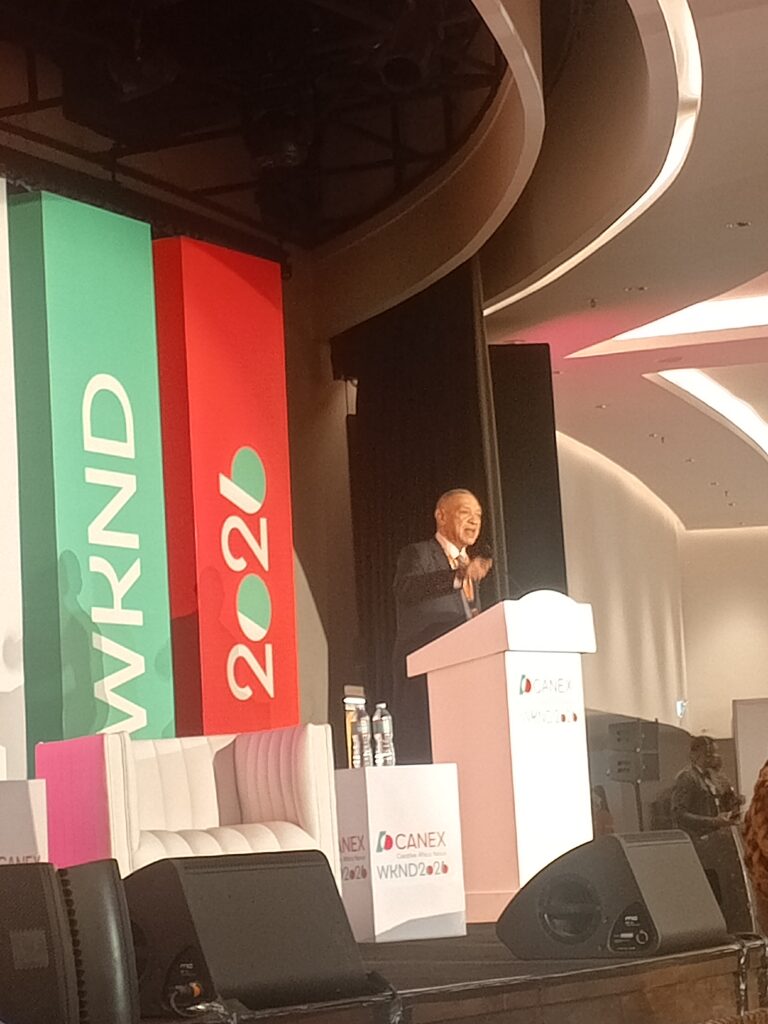
Ben Murray-Bruce, Founder of Silverbird Group, has identified democracy, political participation and improved access to financing as critical to the growth of Africa’s creative industry.
Murray-Bruce made the assertion at the opening remarks at a panel session titled “One Market, One Culture: Building the Creative Economy of Global Africa” during the Creative Africa Nexus (CANEX) WKND 2026 at the Wole Soyinka Centre for Culture and Creative Arts, Lagos.
CANEX WKND is an initiative of Afreximbank.
The News Agency of Nigeria (NAN) reports that 2026 CANEXWKND programme spans film and television, music, fashion, sport, literature and publishing, gastronomy and visual arts, with a strong focus on finance, intellectual property, technology, skills, investment and market access.
Across the four-day programme, CANEX WKND will provide platforms for deal-making, industry dialogue and sector-specific engagement, including the CANEX Deal Room, with the aim of turning creative talent and ideas into stronger businesses, partnerships and commercial opportunities.
That ambition reflects the evolution of Afreximbank’s commitment to Africa’s creative and cultural industries in 2020, subsequently doubling this to US$1 billion before quadrupling the original commitment financing available to US$2 billion.
The expansion reflects Afreximbank’s wider objective of helping African creators and creative businesses build scalable enterprises, strengthen ownership of intellectual property and retain more of the economic value generated by African culture and creativity.
Murray-Bruce said that Africa’s creative industry had suffered decades of suppression due to slavery, colonialism, military dictatorship and political instability, which limited the development and expression of creative talents.
According to him, democratic governance and media liberalisation have helped create an enabling environment for creativity and the growth of Nigeria’s entertainment industry.
Murray-Bruce recalled the challenges faced by musicians and other creatives during military rule, citing the experiences of Afrobeat pioneer Fela Anikulapo-Kuti, who was repeatedly imprisoned and subjected to persecution.
He said the creative sector had also suffered from societal discrimination, with artists previously regarded as unworthy professions and discouraged from pursuing creative careers.
He, however, said creativity thrived on individuality and diversity, stressing that artistic expression could not flourish under uniformity and repression.
Murray-Bruce urged African creatives to actively participate in politics and seek elective offices to influence policies that would promote the industry.
He proposed that governments allocate at least 2.5 per cent of national lending to the creative sector to improve access to financing and support infrastructure development.
He also called for stronger copyright protection, noting that intellectual property should be recognised as valuable collateral for accessing finance.
According to him, African creatives must move beyond seeking assistance from governments and international institutions to actively shaping policies and legislation through political participation.
He urged stakeholders to take deliberate steps toward political participation and policy reforms to ensure sustainable growth in Africa’s creative economy. (NAN)