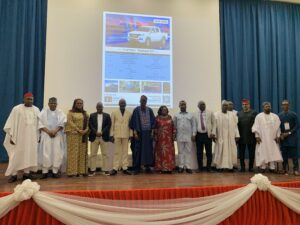
The President, Real Estate Developers Association of Nigeria (REDAN), Oba Adeoye, has urged real estate developers to end “silo” operations and embrace greater collaboration to strengthen the association.
Adeoye made the call on Wednesday at a one-day summit organised for real estate developers in the North-Central Zone in Abuja.
The summit, which has its theme “Collaborate to Consolidate,” focused on strengthening cooperation and knowledge-sharing among developers.
Adeoye said REDAN could only become a stronger institution if its members, state chapters, zones and national leadership worked together.
He said effective collaboration would enable members to share knowledge, opportunities and experiences for the collective growth of the association.
According to him, the theme of the summit is a call for members to abandon isolated operations and embrace collective action.
“The theme ‘Collaborate to Consolidate’, let me give those words a very simple interpretation, we cannot continue to build in silos,” Adeoye said.
He emphasised that developers could not continue to build their companies independently without benefiting from the knowledge and experience available within the association.
Adeoye added that REDAN’s state chapters and zones should not operate independently because stronger cooperation would promote the development of the association.
He said the principle of collaboration should begin within REDAN before members could effectively advocate cooperation across the wider real estate industry.
The REDAN president noted that the association had members with considerable expertise in different aspects of real estate development.
He listed land acquisition, development, finance, construction, project management, planning, sales and affordable housing among the areas in which members possessed expertise.
Adeoye added that members also had knowledge of government engagement, community relations, housing finance, consumer relations and technology.
He said the wide range of expertise available within REDAN presented an opportunity for members to collectively address challenges confronting the real estate industry.
According to him, the major challenge was not a shortage of professional capacity but the inability to effectively connect and harness the capacity already available within the association.
“How do we collaborate among ourselves to ensure that we harness these expertise and strengths?” he asked.
Adeoye said REDAN needed to create stronger platforms through which members could exchange ideas and experiences that would benefit the entire association.
He stressed that successful strategies developed by one state chapter should be shared with other chapters experiencing similar challenges.
According to him, solutions achieved by a particular chapter should not be kept within that chapter when other members could benefit from the experience.
“If Lagos REDAN is facing land problems and maybe they recorded a breakthrough, that breakthrough should be shared with other state chapters. It should not be pocketed by Lagos,” he said.
He said such knowledge-sharing would enable REDAN to develop collective solutions to common challenges confronting developers across the country.
Adeoye also called for improved information flow between REDAN’s national leadership, zones and state chapters.
He explained that challenges experienced by developers at the state level should be communicated to the national leadership and used to strengthen the association’s advocacy efforts.
He added that opportunities secured through the national leadership should be effectively communicated and made available to members across the country.
Adeoye said greater collaboration could also enable REDAN members to negotiate better deals through economies of scale.
He cited the vehicle arrangement facilitated by the North-Central Zone as an example of the benefits that could be achieved through collective purchasing.
According to him, a larger nationwide purchase involving more developers can attract better prices and discounts than a smaller transaction involving only one zone.
“If North-Central Zone is buying 100 vehicles, it is different when REDAN National, as in all of us, are buying 500 vehicles. We can enjoy economies of scale and discounts,” he said.
The president further encouraged developers to leverage the experience and expertise of one another to strengthen their businesses and contribute to industry development.
He said lessons learnt by individual members should be shared with the association rather than being kept exclusively within their respective companies.
Earlier, Mr Osilama Osilama, National Vice President, REDAN North-Central Zone, called on the Federal Government to adopt measures aimed at reducing the rising cost of cement and iron rods.
Osilama said the continuous increase in the prices of the materials was making it increasingly difficult for developers to provide affordable housing.
He explained that cement and iron rods were essential material for housing construction but were also heavily used in road construction, thereby increasing demand and putting pressure on prices.
“One major challenge is the increased demand for cement and iron rods, which are essential housing materials but are also heavily used in road construction,” he said.
Osilama said increased demand had driven prices upward while local production capacity remained largely unchanged.
He recommended liberalising the cement and iron rod market by granting more licences to importers and allowing new manufacturers to operate.
Osilama, who suggested that government could require road contractors to use imported materials or provide targeted subsidies for critical housing inputs, called for the removal of taxes on cement and iron rods to reduce construction costs.
Also speaking, Bature Muhammad, National President and Chairman of Council of the Nigerian Institution of Estate Surveyors and Valuers (NIESV), urged developers and investors to properly structure and document partnerships.
Muhammad, represented by Mr Ebuka Ani, said real estate development required land, capital, expertise, technology and market knowledge, stressing that properly structured collaboration could unlock land, mobilise capital, share risks and improve project delivery.
He urged parties entering into partnerships to clearly agree on their contributions, responsibilities, sharing ratios and expected returns before commencing projects.
He also encouraged landowners to use their land as equity and investors to conduct proper checks on property titles, valuation, approvals and other risks before investing.(NAN)