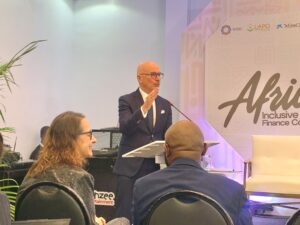
Stakeholders in the financial sector have called for climate finance that addresses the needs of women, smallholder farmers and MSMEs, instead of relying solely on conventional lending models.
They made the call at the Africa Inclusive Climate Finance Conference organised by LAPO Microfinance Bank (LAPO MfB), in partnership with the World Savings and Retail Banking Institute (WSBI), in Lagos on Thursday.
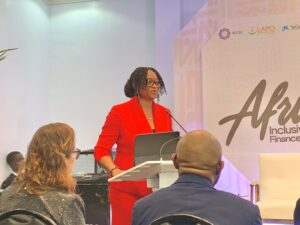
Angela Omeiza, ESG Board Chairperson, LAPO MfB, said financial inclusion should not only help people build businesses and livelihoods but should also help protect what they had built.
Omeiza illustrated the challenge with the story of “Amina”, a woman farmer and business owner who farms, sells foodstuff, keeps livestock and employs others, while diversifying her activities to cope with economic and climate pressures..
She said women like Amina were already creating economic value and should not be treated merely as beneficiaries waiting to be empowered.
According to her, gender-smart finance should be designed around women’s realities, while climate-smart agriculture should focus on making farming more productive, efficient, resilient and innovative.
Omeiza said climate shocks could destroy crops, livestock and assets acquired through borrowed funds, stressing the need to integrate insurance, risk-sharing and other forms of protection into financial inclusion programmes.
“If finance doesn’t reach her, who exactly are we building for?” she asked.
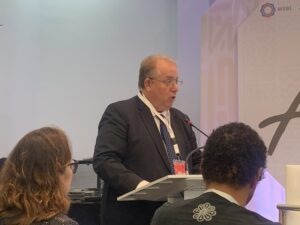
Peter Simon, Chief Executive Officer, WSBI, said the vulnerability of smallholder farmers to climate change demonstrated the urgent need to expand adaptation finance.
Simon said more than 80 per cent of Nigerian farmers were smallholders producing about 90 per cent of the country’s food, while four out of five smallholder farmers were financially vulnerable to climate-change consequences.
He said WSBI’s collaboration with LAPO MfB and other partners had reached about 20,000 smallholder farmers and 5,000 MSMEs through climate-adaptation credit.
Simon said the financing supported practical adaptation measures, including resilient seeds, irrigation, water management and renewable energy.
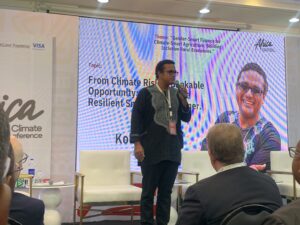
Kola Masha, Managing Director, Babban Gona, said farmers should not automatically be considered too risky to finance because of climate-related risks.
He said appropriate financing could help farmers adopt measures that reduced climate-related losses, adding that Africa’s climate-adaptation lending market represented an estimated 200 billion dollars opportunity.
Masha said Babban Gona had served more than 500,000 smallholder farmers and deployed over 250 million dollars in financing, with a 99 per cent repayment rate.
He said the organisation was also developing an Impact Accelerator Fellowship to help agro-processors build stronger relationships with farmers, improve their financing readiness and create deeper risk-sharing channels for financial institutions.
Ali-Amine Nejjar, WSBI Vice President, Africa Regional President and Chairman of the Management Board, Al Barid Bank, Morocco, said MSMEs needed financing tailored to their development cycles, alongside digital tools, capacity building and appropriate risk-sharing mechanisms.
Nejjar said Africa should develop its own inclusive-finance models based on community engagement, innovation, solidarity and inclusive growth instead of simply replicating approaches designed for other regions.
Weselina Angelow, Director of Programmes, WSBI, said financial institutions needed better data to understand the people they were trying to serve.
Angelow said banks should examine who applied for financing, who dropped out, who was rejected and why, while also investigating the barriers preventing some women from applying in the first place.
She said climate-adaptation financing did not necessarily require sophisticated financial products, but rather an understanding of customers’ specific climate risks and the ability to finance practical and economically sensible solutions.
Angelow said the focus should move beyond financial inclusion to “economic inclusion,” with evidence and data used to improve decision-making.
The stakeholders urged financial institutions and development partners to strengthen partnerships and risk-sharing mechanisms to ensure climate finance reached underserved communities and translated into sustainable economic opportunities. (NAN)