Before sunrise at the Nigeria–Benin border in Seme-Krake, Bridget Okafor counts her naira and West African CFA francs, slipping both bundles into a pouch beneath her wrapper.
For eight years, she has supplied cassava flour and dried hibiscus to buyers in Cotonou and Accra.
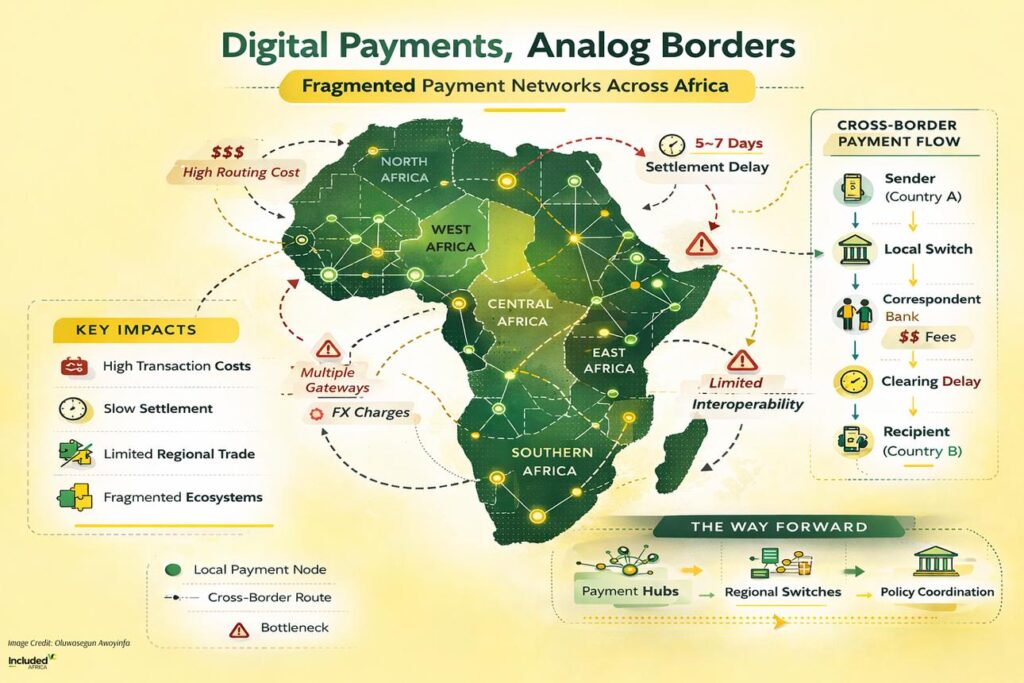
Yet every journey across the coastal corridor remains a financial obstacle course.
To pay suppliers and receive customers’ payments, Okafor relies on roadside currency changers, informal brokers or bank transfers routed through correspondent banks in New York and London.
Transfers can take seven business days and consume seven per cent to 12 per cent of her profit margin.
“My buyers in Ghana want to pay in cedis, my suppliers in Benin want CFA, and my bank in Nigeria tells me to find dollars first.
“By the time the money settles, the exchange rate has moved and half my profit is gone,” she said.
Central banks, multilateral institutions and fintech companies have invested in instant, local-currency payment infrastructure to connect fragmented markets and support trade under the African Continental Free Trade Area (AfCFTA).
At the centre is the Pan-African Payment and Settlement System (PAPSS), backed by the African Export-Import Bank (Afreximbank), alongside regional payment networks and fintech platforms.
Afreximbank estimates the systems could save African businesses more than five billion dollars annually in currency-conversion and correspondent-banking costs.
Yet regulatory fragmentation, foreign-exchange constraints, uneven digital infrastructure and limited awareness continue to exclude many micro, small and medium-sized enterprises (MSMEs).
Because many African currencies are not directly convertible, a Nigerian importer buying from Ghana may convert naira into dollars, route the funds through a correspondent bank in the United States or Europe, and have the receiving bank convert them into cedis.
The double conversion raises costs and exposes businesses to exchange-rate volatility.
Commercially unveiled in Accra in January 2022, PAPSS was designed to reduce this dependence on intermediary currencies.
It connects central banks and commercial financial institutions, allowing a Nigerian business to pay in naira while a supplier in Ghana receives cedis. Participating institutions subsequently settle their net positions.
“We are not chasing de-dollarisation because Africa still needs to trade with the rest of the world. But when Africa trades with itself, let us use PAPSS to reduce the amount of foreign currencies required.
“When a trader in Lagos has to buy dollars just to pay a weaver in Accra, we are subsidising foreign clearing houses and starving our own central banks of reserves.
“Local-currency settlement isn’t just a technical upgrade — it is economic sovereignty,” said Mike Ogbalu, Chief Executive Officer of PAPSS.
More than 22 Nigerian commercial banks, including First Bank, Access Bank, UBA, Sterling Bank, and Wema Bank, have integrated PAPSS across their branches and digital channels.
To boost small-scale cross-border trade, CBN guidelines allow Nigerian SMEs to make eligible monthly payments of up to 5,000 dollars, while individuals can transact up to 2,000 dollars.
Adoption among ordinary traders, however, remains uneven, particularly along the Nigeria-Benin corridor.
A major obstacle is West Africa’s fragmented monetary and regulatory architecture.
Nigeria and Ghana are among the early PAPSS participants through the West African Monetary Zone (WAMZ) framework.
Benin, however, belongs to the eight-country West African Economic and Monetary Union (WAEMU), which uses the CFA franc, pegged to the euro and managed under the regional monetary framework of the Central Bank of West African States (BCEAO).
Differences in regulatory approvals, anti-money-laundering rules, foreign-exchange arrangements and settlement procedures complicate efforts to connect the zones.
At Lagos’s Mile 12 International Market, many traders remain unfamiliar with PAPSS.
Chinedu Eze, an importer of woven fabrics and cosmetics from Benin and Ghana, shared his experience.
“If I walk into my bank branch and ask to pay a supplier in Cotonou in naira, half the tellers look at me like I am speaking French.
“Even when the app works for Ghana, my supplier in Benin wants mobile money or cash CFA. If the system doesn’t connect directly to the phone in his pocket, it doesn’t solve my problem,” he said.
The AfricaNenda Foundation’s State of Inclusive Instant Payment Systems (SIIPS) in Africa Report 2026 identifies 39 live instant payment systems across Africa, but only 16 support cross-border transactions.
The World Bank’s Global Findex 2025 puts the share of African adults without a formal bank account or mobile-money wallet at about 42 per cent.
Nigeria’s payment ecosystem is largely bank-account driven through the Nigeria Inter-Bank Settlement System (NIBSS) Instant Payment infrastructure. In Ghana and Benin, mobile-money services such as MTN MoMo, Telecel Cash and Moov Money are widely used.
A Nigerian SME using a banking app to pay a supplier in Kumasi or Porto-Novo who relies on mobile money needs affordable, direct wallet transfers with transparent fees and clear dispute resolution.
This gap hits women hardest, as they make up 60 per cent to 70 per cent of West Africa’s informal cross-border traders. Without reliable digital payments, many are forced to carry cash across borders, exposing them to theft, unfair exchange rates, and extortion.
Funmilayo Adeyemi, founder of a 14-person skincare and shea-butter export business in Ibadan, began supplying boutique retailers in Accra in 2024.
Her Ghanaian customers initially used informal agents, who charged up to nine per cent and sometimes delayed remittances for days.
“When you are a small business, a five-day settlement delay freezes your entire working capital.
“I couldn’t buy raw shea nuts from women cooperatives in Kwara State until my Accra invoice cleared,” she said.
In 2025, Adeyemi adopted a Nigerian cross-border fintech platform alongside a PAPSS-enabled corporate account with her bank. She said settlement time fell from five days to less than an hour, while transaction costs dropped by more than half.
She still faces difficulties with smaller Ghanaian boutiques that lack registered corporate bank accounts or struggle to meet Know-Your-Customer (KYC) requirements.
Lagos fintech executives argue that technology companies can help bridge gaps left by conventional banks.
Platforms such as Flutterwave, Paystack, Leatherback and Klasha have developed payment infrastructure that enables merchants to collect payments in foreign currencies, including cedis and CFA francs, with settlement options varying by market and service.
Some fintechs have experimented with dollar-pegged stablecoins to navigate illiquid foreign-exchange corridors, attracting regulatory scrutiny over capital flight and monetary stability.
Ibrahim Bakare, Chief Operating Officer of Lagos-based cross-border payment startup HAQ Technology Management Services, says closer collaboration between fintechs and banks is essential.
“Fintechs have the user experience and the merchant relationships, while banks hold the central-bank settlement licences and PAPSS direct-participant status.
“When regulators allow fintechs to plug directly into PAPSS as indirect participants rather than forcing us to negotiate slow bilateral deals with multiple banks, costs for SMEs drop overnight,” he said.
Bankers caution that technology cannot resolve foreign-exchange liquidity constraints on its own.
Under PAPSS arrangements, participating financial institutions must maintain adequate settlement liquidity to support transactions. Trade imbalances also require banks and central banks to manage net settlement positions.
“Instant messaging does not magically create foreign-exchange liquidity out of thin air.
“What PAPSS does brilliantly is net off offsetting trade flows so we only settle the difference, dramatically reducing hard-currency demand.
“Now our job is customer education – training branch relationship managers and showing SMEs that they don’t need a domiciliary dollar account to trade with Accra,” said a head of trade finance at a tier-one Nigerian bank in Benin City, who requested anonymity.
The Central Bank of Nigeria and Bank of Ghana use tiered KYC to expand low-value access, while ECOWAS aligns regional payments with the AfCFTA Digital Trade Protocol and PAPSS adds a currency marketplace for local-currency liquidity.
Success hinges on affordability, reliability, digital literacy, network access, and customer support.
Back at Seme-Krake, Okafor has begun to experience the benefits.
She opened a tiered business account with a Nigerian bank offering mobile PAPSS transfers and attended a digital-literacy workshop.
In August, she completed her first digital invoice settlement from a buyer in Accra, receiving the payment in her Nigerian account before her driver had completed customs clearance.
She still carries CFA francs to pay suppliers in Cotonou because the payment connections she needs across the Nigeria-Benin corridor remain incomplete.
“The phone transfer worked in two minutes, and I didn’t lose a single kobo to street changers.
“If they can make Benin work the exact same way, I won’t ever carry cash across this border again,” she said.
For Nigerian SMEs and their regional counterparts, the value of instant payments extends beyond transaction speed.
It offers the ability to conduct cross-border trade without eroding profit margins through expensive, delayed, and complex payment processes. (NANFeatures)