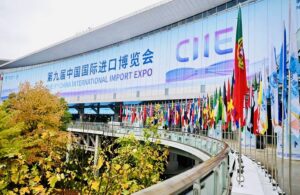
The Shanghai National Exhibition and Convention Centre, venue of the 9th China International Import Expo (CIIE).
For Africa, access to China’s vast consumer market could offer more than opportunities to sell agricultural commodities and mineral resources.
It could also support industrialisation, value addition, investment and stronger integration into global supply chains.
These prospects took centre stage at the ninth China International Import Expo (CIIE), held from Nov. 5 to Nov. 10 in Shanghai.
Shanghai is southern China’s strategic economic hub with an estimated 800 billion dollars nominal GDP and nearly 30 million population.
The six-day event combined commercial engagements, investment discussions and economic diplomacy, bringing thousands of products before buyers from China and across the world.
More than a conventional trade exhibition, the CIIE has evolved into a platform through which China is positioning its vast consumer market as an engine of international trade, investment and economic cooperation.
For Africa, the opportunities extend beyond selling agricultural commodities and minerals.
They include value addition, industrial development, technology partnerships, employment generation and integration into global supply chains.
Held at the Shanghai National Exhibition and Convention Centre, the ninth edition attracted 4,142 overseas exhibitors from 162 countries, regions and international organisations, covering more than 440,000 square metres.
More than 300 Fortune Global 500 companies and industry leaders participated, while over 480 exhibits made their global, Asian or Chinese debuts.
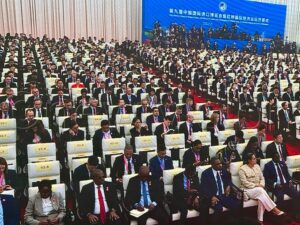
Chinese Vice Premier Ding Xuexiang, addressing the opening ceremony, described the CIIE as a major initiative demonstrating China’s commitment to trade liberalisation, economic globalisation and opening its market to the world.
“The CIIE has evolved from a one-sided invitation extended by China into a shared commitment of all parties,” Ding said.
Since its inauguration in 2018, the expo has become an annual meeting point for businesses seeking access to Chinese consumers and commercial opportunities.
Its first eight editions attracted participants from more than 180 countries, regions and international organisations, with cumulative intended transactions exceeding 580 billion dollars.
Ding said China’s goods-import volume had remained the world’s second-largest for 17 consecutive years, making it a major export destination for nearly 80 countries.
Imports grew by 22.3 per cent in the first three quarters of 2026, nearly six percentage points above export growth.
For developing economies seeking alternative markets amid global trade uncertainties, these figures point to considerable opportunities.
A particularly significant development for Africa is China’s expansion of zero-tariff treatment to all 53 African countries with which it maintains diplomatic relations.
The policy, which took effect on May 1, 2026, builds on earlier preferential access for 33 African least-developed countries.
For the remaining 20 eligible countries, the arrangement applies for an initial two-year period, until April 30, 2028, subject to relevant preferential tariff and product-specific provisions.
By reducing import duties, the policy can lower the cost of entering China’s market and improve the competitiveness of eligible African products.
Products including South African apples, Kenyan avocados, Egyptian citrus fruits, Moroccan gypsum and Nigerian bovine bone chips have entered China under the arrangement.
Chinese Foreign Ministry spokesperson, Guo Jiakun, said the initiative was accompanied by “improved customs procedures, agricultural inspection arrangements and trade facilitation measures, including streamlined quarantine clearance.”
The practical value is evident in early shipments.
Shanghai Customs reported that 516 tonnes of Egyptian oranges cleared Waigaoqiao port on May 1, becoming the city’s first import under the expanded arrangement.
The Chinese importer reported tariff savings of about 320,000 yuan. A shipment of Kenyan avocados reportedly saved its importer approximately 26,000 yuan.
Such savings can improve profit margins and make African goods more competitive.
However, market access alone cannot guarantee export growth.
Governments and businesses must understand Chinese regulations, certification requirements, consumer preferences and distribution systems while ensuring consistent quality and supply.
For Rwanda’s Ambassador to China, retired Lt.-Gen Emmanuel Karake, CIIE provides local businesses with an important platform to connect with Chinese buyers.
“CIIE has proven to be an invaluable platform for Rwandan enterprises, particularly smallholder farmers and women-led cooperatives, to access the Chinese market and build lasting business partnerships.
“Every cup of Rwandan coffee or taste of our honey enjoyed by Chinese consumers represents an opportunity to support Rwandan farmers, families and entrepreneurs,” he said.
Hassan Mohammed, Nigerian Trade Commissioner in Shanghai, while agreeing with the Rwandan envoy, described the CIIE as a “veritable platform for opening new export frontiers for Africa.”
Some African entrepreneurs who exhibited their products at China’s biggest import expo included sellers of spices and foodstuff from Nigeria, Rwandan coffee and tea merchants, Zambian gemstone, Ghanaian chocolate producers and craft sellers from South Sudan.
They, however, said they were confronted by challenges of transport costs, export procedures and the difficulty of securing commercial partners, in spite of China’s expansion of tariff-free access for African goods.
Zambia’s Teresa Stumbeko, CEO, Colourful Culture, who exhibited malachite and amethyst sourced from her country, said Chinese customers showed interest in the stones, but transporting larger quantities to China posed a difficult challenge.
“We are expecting that we can have a market in China, the company is ready to supply both roasted and green coffee,” Rwanda’s Ivan Shema, founder of 1000 Hills Products, told journalists.
Ghana’s Eric Agbozo, chief executive of Sekoko Enterprise, exhibiting an African chocolate to Chinese and international consumers, said his products combined cocoa with ingredients like nuts, seeds, dates, banana, coconut and ginger.
“What we are seeking to do is combine all this into a healthier chocolate for Africa and for the world at large,” he said.
The CIIE opportunity intersects with the African Continental Free Trade Area (AfCFTA), which seeks to create a single African market for goods and services.
This is because it also seeks to progressively reduce tariffs on most intra-African trade and ease barriers across national borders.
By expanding trade among African countries, the agreement can help producers reach larger markets, achieve economies of scale and develop stronger regional supply chains.
The AfCFTA can also prepare African businesses to exploit opportunities such as China’s zero-tariff access.
Producers could source inputs from neighbouring countries, process commodities regionally and distribute finished products across the continent before exporting competitively to China.
Cooperation on standards, customs procedures, logistics and rules of origin would further strengthen their capacity to meet international market requirements.
The two initiatives should therefore be complementary as AfCFTA can strengthen Africa’s productive base and intra-African commerce, while preferential access to China provides an expanded external market.
Together, they offer opportunities to move from fragmented commodity exports towards regional value addition, diversified exports and stronger bargaining capacity in international trade.
A central challenge highlighted by the CIIE is the need to move beyond exporting unprocessed resources.
For decades, many African economies have depended heavily on crude oil, minerals and primary agricultural commodities, limiting domestic employment, industrial capabilities and the share of value retained locally.
China’s experience illustrates the possibilities of connecting production, technological innovation, infrastructure and international trade.
Ding said foreign-funded enterprises accounted for 27 per cent of China’s total exports in 2025, underlining the role of international investment in manufacturing and export development.
He also highlighted China’s support for industrial parks in Africa, Southeast Asia and other developing regions, aimed at promoting employment, industrialisation and improved trading conditions.
For African countries, this presents opportunities to attract investment into manufacturing, agro-processing, mineral beneficiation, renewable energy and other productive sectors.
Cocoa-producing countries, for example, could develop competitive chocolate and processed-food industries rather than exporting mainly raw beans.
African counties like Nigeria, which are endowed with lithium, gold, coal, manganese and iron ore, among others, could pursue processing, refining and manufacturing investments.
One notable African contribution at this year’s expo came from Gabonese President Brice Nguema, who presented his country’s participation as an opportunity to attract investment and accelerate economic diversification.
Gabon showcased its resources, biodiversity and investment opportunities through its first national pavilion.

Nguema said his administration was seeking to shift from dependence on raw-material exports towards domestic processing and stronger local value chains.
“Come and invest in Gabon and build with us the new edifice of our dreams,” he told business leaders.
He identified timber, manganese, iron ore, energy, agriculture, digital infrastructure and the green economy as priority sectors.
The President also invited investors to the operational Nkok Special Economic Zone, highlighting its incentives and industrial potential.
His presentation illustrated how African participation in trade exhibitions can extend beyond displaying products to attracting investment that transforms domestic production.
The challenge, however, is converting expressions of interest into bankable projects, functioning industries, technology partnerships and employment opportunities.
This requires credible policies, reliable electricity and transport infrastructure, regulatory transparency and predictable investment conditions.
Alexander De Croo, United Nations Development Programme (UNDP) Administrator, said expanded duty-free access for least-developed countries and African partners offered important opportunities but cautioned that market access was only the beginning.
“The real task, the larger task, is to build productive capacity that can make use of that market access,” he said.
His observation captures a major constraint facing developing economies.
Without production capacity, industrial infrastructure, technical expertise and finance, countries may struggle to benefit from preferential trade arrangements.
De Croo said development gains were greatest when countries created more value domestically, strengthened industries and generated skills and employment.
He identified infrastructure, technology transfer, financing and institutional development as essential components of economic transformation.
He also highlighted the employment challenge, noting that about 1.2 billion young people worldwide would enter the labour market over the next 15 years.
This makes productive investment particularly urgent for Africa, where a youthful population represents both an opportunity and a development responsibility.
De Croo argued that trade should be assessed by its contribution to local employment, environmental sustainability, gender equality and poverty reduction.
“Trade can be an incredibly powerful accelerator” for sustainable development, he said.
Another important dimension of the CIIE was its emphasis on technological innovation and emerging industries.

The exhibition featured 633 innovation and technology projects from nearly 40 countries and regions, reflecting the growing importance of technological collaboration in international commerce.
Ding said China’s competitiveness increasingly reflected sustained research investment, industrial innovation and technological advancement.
He disclosed that integrated-circuit exports rose by 99.1 per cent in the first three quarters of 2026, while exports of the so-called new three products; electric vehicles, lithium-ion batteries and solar photovoltaic products, increased by 45.6 per cent.
He expressed China’s readiness to deepen scientific and technological cooperation, particularly in digital development, green technologies and industrial upgrading.
For developing economies, these sectors offer opportunities to participate in emerging industries beyond traditional commodity exports.
African countries could explore partnerships in solar technologies, agricultural machinery, electric mobility, digital services and industrial automation while building local technical expertise.
Such cooperation should incorporate skills development, local participation and meaningful knowledge transfer.
China’s manufacturing experience also offers lessons in building industrial ecosystems that connect research institutions, manufacturers, suppliers and distribution networks.
Austria’s Chancellor, Christian Stöcker, also highlighted the value of sustained international economic engagement.
He described Austria-China relations as a longstanding partnership and said more than 650 Austrian companies operated successfully in the Chinese market.
“Economic exchange creates opportunities, prosperity and mutual understanding,” Stöcker said, while stressing fair competition, transparency and constructive dialogue.
His remarks demonstrated the breadth of international interest in China’s market and the importance of dependable businesses and mutually beneficial commercial relationships.
The CIIE’s accompanying Hongqiao International Economic Forum provided another platform for governments, businesses and international organisations to discuss global economic challenges.
An important development this year was the introduction of the first Export-to-China Capacity Development Report.
It examines China’s import structure, market demand, trading entities and policy environment, offering exporters information to identify opportunities and strengthen their capacity to supply Chinese consumers.
Ding projected that China’s annual retail sales of consumer goods would reach approximately 60 trillion yuan by the end of the 15th Five-Year Plan period, while its services sector would exceed 100 trillion yuan.
These projections point to potential opportunities for suppliers of agricultural products, consumer goods, healthcare, tourism, education and other services.
For Africa to benefit, governments and businesses must invest in agricultural productivity, cold-chain facilities, modern ports, transport networks, industrial capacity and internationally recognised quality standards.
Export finance, market intelligence and partnerships linking small producers with international distributors are equally important.
Nigeria, for instance, could expand exports in processed agricultural products, food, minerals, pharmaceuticals and creative industries.
Its resource base and manufacturing potential could support a more diversified trade relationship with China, provided policies connect farmers, manufacturers, exporters, financiers and international buyers.
Ultimately, the ninth CIIE offers an opportunity to reconsider the relationship between international trade and economic development.
China’s import market, preferential tariff arrangements and investment partnerships provide additional avenues for developing economies.
However, the benefits will depend on their capacity to produce competitively and negotiate partnerships that advance domestic priorities.
For Africa, the expo should be more than an annual exhibition.
It is a platform to identify markets, attract investment, build industrial partnerships and strengthen the continent’s position in global production networks.
The AfCFTA can reinforce that effort by creating a stronger regional market from which African businesses can scale up and compete internationally.
The measure of success will not simply be the number of exhibitors, products displayed or agreements announced.
It will be whether these engagements produce factories, competitive exports, technological capabilities, decent jobs and sustainable prosperity.
As Shanghai brings the world’s commercial communities together, the message for Africa is that access to China’s market is an important opening.
Investment, industrialisation, regional integration and strategic preparation will however determine how much lasting value the continent derives from it.
(NAN