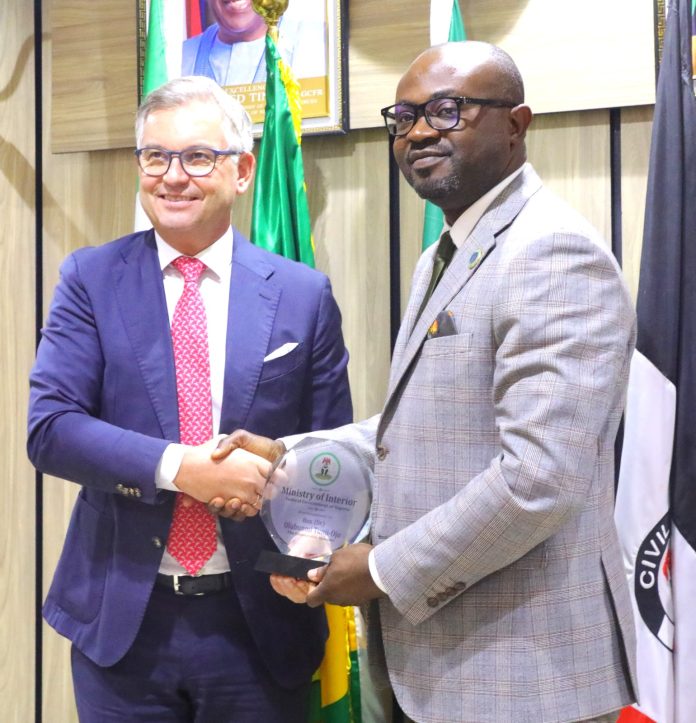
Mr Magnus Brunner, the European Commissioner for Internal Affairs and Migration, has met key members of the Nigerian government in Abuja to advance cooperation on migration, security, and other shared priorities.
The key members include Amb. Bianca Odumegwu-Ojukwu, Minister of Foreign Affairs; Mr Lateef Fagbemi, Attorney-General and Minister of Justice; Dr Olubunmi Tunji-Ojo, Minister of Interior; and Dr Bernard Doro, Minister of Humanitarian Affairs and Poverty Reduction.
This is contained in a statement released on Wednesday by Mr Modestus Chukwulaka, Press and Information Officer, EU Delegation to Nigeria and ECOWAS.
Brunner’s visit comes as the EU continues to strengthen its engagement with Nigeria as one of its key partners in Africa.
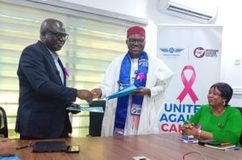
According to the delegation, the longstanding partnership on migration is now stronger following the signing of the EU-Nigeria Readmission Agreement (EURA) on Tuesday.
It said the partnership had already led to bilateral efforts to strengthen cooperation on migration management, with significant improvements in previous years.
It cited cooperation between Nigeria and EU agencies, including Europol, Eurojust and Frontex.
The EU has recently allocated 66 million euros to fund new migration-related projects.
The statement said the security partnership had also grown steadily in size and scope, with the EU recently allocating 26 million euros to security actions, including countering the proliferation of small arms and drug trafficking.
It added that the EU had adopted its first-ever bilateral assistance measure to Nigeria under the European Peace Facility, worth 20 million euros, to support Nigeria’s counterterrorism efforts.
The bloc said Nigeria and the EU were longstanding partners who shared a resolute commitment to multilateralism and a rules-based order.
It said Team Europe, comprising the EU and its member states, was actively implementing the Global Gateway, the EU’s sustainable offer to external partners, in Nigeria through key projects in a wide range of sectors.
According to the statement, bilateral relations have gained momentum, notably following the 8th EU-Nigeria Ministerial Meeting held in Abuja in March, attended by High Representative/Vice-President Kaja Kallas.
It noted that Nigeria’s central role in West Africa and the wider region makes it a key partner for the EU on regional economic cooperation, security, migration and trade.
The statement said the commissioner’s visit provided an opportunity to take stock of the partnership, advance cooperation on shared priorities and prepare the ground for engagement in areas beyond migration and security.
Speaking at the meeting, Brunner said: “Nigeria is a key partner for Europe, and our ties are steadily growing stronger. Together we are turning dialogue into action.
“More security, better migration management, joining forces to bring results. We are turning the huge potential of our partnership into mutual benefit,” he said.
The News Agency of Nigeria (NAN) reports that the EURA establishes reciprocal procedures for returning individuals who lack legal status.
Under the agreement, EU member states can return Nigerian citizens who no longer have the legal right to remain in Europe, and vice versa.
The terms apply strictly to irregular migrants and do not affect Nigerians living, studying or working in Europe with valid visas or residence permits.
An estimated 260,000 Nigerians are legally resident in the EU. (NAN)