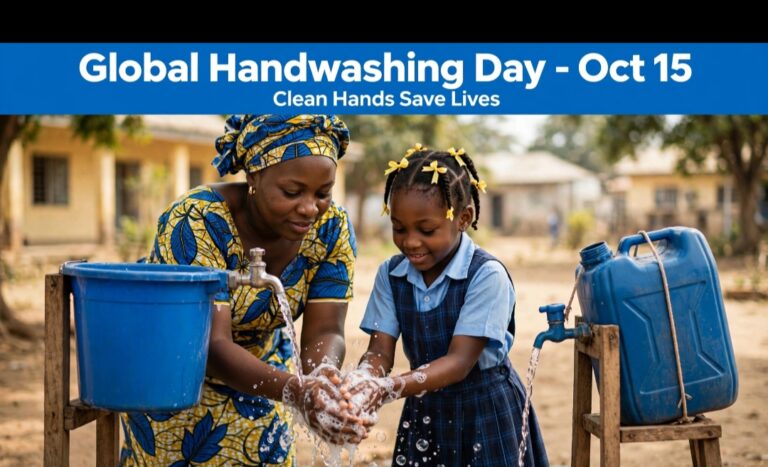
For Mrs Nikky Akah, a provision vendor popularly known as Mama Chichi at Bodija Market in Ibadan, washing hands with soap is a luxury the market does not offer.
Akah laments the absence of basic water and sanitation infrastructure in the market.
“There is no provision for people to wash hands in the market. The only available facility is commercial, and you have to pay money before you can access it,” Akah says.
She also expresses concern over inadequate public toilets and urges the Oyo State Government to provide functional water points.
Her complaint captures a widespread challenge facing some households, schools, markets, and some healthcare centres across Ibadan as the world marks Global Handwashing Day.
Commemorated annually on Oct. 15, Global Handwashing Day raises awareness on the importance of handwashing and its role in hygiene and good health.
The theme for 2026 observance is “Be a Handwashing Hero”.
According to the World Health Organisation (WHO), washing hands often with soap is an easy way to stay healthy. It encourages people to wash their hands before eating and preparing food, after using the toilet, and after cleaning a child’s bottom.
However, stakeholders emphasise that access to functional facilities, rather than awareness alone, determines whether citizens practise proper hand hygiene.
Dr Eno Onen, a Community Physician at the University College Hospital (UCH), Ibadan, says structural barriers remain the major obstacle to effective handwashing.
Citing a 2024 study of 394 in-school adolescents in Ibadan Southwest Local Government Area (LGA), he says knowledge and access remain unequal.
“The study reveals that only 58.4 per cent of respondents possessed adequate hand hygiene knowledge, with a sharp disparity between private schools at 72.8 per cent and public schools at 44.4 per cent.
“The reported barriers were poor water supply, long distance to washing stations, inadequate soap, and forgetfulness,” Onen explains.
He notes that many public schools lack boreholes and force students to fetch water from distant wells. The challenge is not only ignorance, but also the absence of water, soap, and nearby washing points.
Onen also refers to a 2020 clinical study at Adeoyo Maternity Hospital, Ibadan, which shows that healthcare workers possess sound knowledge but face resource gaps and workflow pressure.
In hospitals, poor hand hygiene can transfer infections between patients, caregivers, and health workers, he notes.
On practical solutions, Onen argues that live demonstrations combined with accessible facilities produce lasting results, compared with public information jingles.
He highlights a 2024 initiative in Ibarapa-East LGA by the Oyo State Rural Water Supply and Sanitation Agency (OYORUWASSA), UNICEF, and Sato Lixil.
“They paired facility installation with live handwashing demonstrations for children and parents, rather than relying on talk alone.’’
He says the solution is to place washing facilities close to the people who need them and teach hygiene through practical demonstration.
On national indicators, Onen cites the 2024 Nigeria Demographic and Health Survey (NDHS), which reveals that only 37 per cent of the national household population has a basic handwashing facility with soap and water on the premises.
He states that this represents an increase from 29.7 per cent in 2021, but extreme regional disparities persist, from one per cent in Taraba to 85 per cent in Rivers State.
“In Oyo, 92 per cent had basic drinking water service and 37 per cent had basic sanitation service,” he adds.
He also cites UNICEF Nigeria’s statement in October 2025 that only 16 per cent of Nigerians have access to basic handwashing facilities at home.
On compliance, Onen cites a 2024 survey of 588 health workers across Oyo, Ogun, and Ondo states, which reveals gaps in routine practice.
To bridge these gaps, he recommends low-cost solutions such as Veronica buckets and tippy-taps in public spaces and institutions.
“Install low-cost, close-by points so no one walks far, tie soap to the station, and pair it with live demos,” Onen states.
He maintains that facility proximity, rather than awareness alone, drives proper handwashing practices in the Ibadan studies.
However, because the figures come from earlier studies rather than 2026 data, he notes that further research is required to assess the present state of sanitation infrastructure.
Household habits are also key to imbibing handwashing practice.
Dr Muyiwa Oguntunde, a Family Physician at Our Lady of Apostles (O.L.A) Catholic Hospital, Oluyoro, Ibadan, advises families to make handwashing a household habit.
Oguntunde says disease-causing germs are invisible to the eye.
He identifies common excuses parents give for skipping handwashing.
“Some parents are in a hurry, while others grew up where handwashing with soap was not a habit.
“Some say there is no water or soap readily available. That is a practical challenge we must address rather than blaming families,” he says.
He stresses that hands may look clean but still carry organisms that cause diarrhoea, cholera, typhoid, and other life-threatening infections.
He emphasises that handwashing is not about removing visible dirt alone, but preventing disease transmission across communities.
The main causes of poor handwashing at home are urgency, weak habits, and lack of accessible soap and water.
Its impact includes repeated infections, medical expenses, missed school days, and avoidable deaths among children.
As such, family rules, then become imperative.
Oguntunde advises that handwashing should become a firm family rule rather than a simple instruction for children.
“I encourage parents to lead by example with a simple rule: before we eat, everybody washes with soap,” he says.
He advises households to place soap and water near toilets and dining areas to make compliance effortless.
Parents can make the routine fun by singing while children scrub for 20 seconds, while older siblings guide younger ones.
He cites fewer hospital visits, reduced medical bills, and fewer missed school days as benefits.
“When parents understand this small action protects the whole household, they take it seriously,” Oguntunde says.
He explains that poor hand hygiene drives recurrent infections, especially where unsafe water and poor sanitation persist. Regular handwashing at critical moments reduces daily exposure to dangerous pathogens.
However, he cautions against attributing a child’s recovery solely to handwashing without medical evidence, noting that diarrhoea stems from multiple environmental factors.
Nevertheless, he maintains that handwashing with soap remains highly effective in lowering disease rates.
“The practical message is prevention begins at home: after using the toilet, before preparing food, and before eating or feeding a child,” he says.
He insists that hand hygiene must combine with safe drinking water, proper food handling, improved sanitation, and routine childhood immunisation.
Achieving stainable goals and impact become shared responsibility, as Oguntunde stresses that Global Handwashing Day reminds people that the most affordable protection is often ignored.
He urges that handwashing must not be reserved for visibly dirty hands or moments when family members fall ill.
“We must teach children early, practise what we preach, and make facilities accessible at home, schools, and markets,” he says.
He describes hand hygiene as both an individual habit and a shared public health responsibility requiring reliable access to clean water and soap.
Oguntunde calls on schools, public institutions, and health professionals to install functional stations and educate communities.
“Make a simple commitment: soap and water before meals, after using the toilet, and before preparing or feeding food,” he urges.
“Small, consistent hygiene practices prevent widespread illness, conserve household resources, and save human lives.
“Clean hands are not a luxury; they are a basic investment in family health,” he adds.
Similarly, handwashing is integral to maternal hygiene.
Mrs Maryam Yekeen, a midwife at Ogunpa Primary Health Centre, Ibadan, says mothers often skip handwashing before breastfeeding when rushing to comfort a crying baby.
“When they hear their babies crying, they quickly carry them and forget to wash hands,” Yekeen explains.
She emphasises that unwashed hands transfer infections, including hospital-acquired infections, to infants. The challenge is urgency and forgetfulness; the impact is increased infection risk among newborns and young children.
To improve compliance, she says health facilities must keep handwashing stations accessible in wards and provide low-cost sanitisers and liquid soap at points of care.
Her solution is to bring hygiene materials directly to mothers and caregivers where they provide care.
Finding its space in school hygiene and in “catching them young”, the Proprietress of Wise Mind Private Schools, Ibadan, Mrs Grace Olubunmi, says persistent education helps pupils build lasting hygiene habits.
“Consistent training eventually makes handwashing a habit and helps prevent disease spread,” she says, adding that orientation matters more than financial cost.
Water sustenance remains costly for schools, while erratic power supply sometimes complicates the provision of water for handwashing facilities.
“Both big and small schools can afford soap, plastic wash-hand basin and tippy-tap bucket according to capacity.
“Each school is meant to provide according to its capacity. Both big and small schools can afford it,” Olubunmi says.
She identifies citizens’ orientation and attitude as the major challenge.
Her solution is continuous school-based education, affordable washing materials, and daily hygiene routines.
Mothers also play a major role in promoting hand hygiene.
Mrs Temitope Alade, mother of a two-year-old, says consistent reminders have made handwashing a routine for her daughter.
“At home, I make sure my under-five child washes her hands with soap before eating and after using toilet by reminding her every time.’’
Alade says her motivation comes from the knowledge that proper handwashing prevents germs and illnesses in children.
“Knowing that proper handwashing prevents germs motivated me to be consistent,” she explains.
She reports that her child rarely suffers from diarrhoea since adopting regular handwashing. She urges parents to remain consistent and make hygiene fun and routine for young children.
For Mrs Esther Esan, another mother of an under-five child, school enforcement complements home efforts.
“My son’s school help reinforce good hand hygiene taught at home.
“As soon as we leave the toilet, he shouts ‘wash hands,’” Esan says.
Her medical background also drives her consistency.
According to her, washing hands with soap before meals and after using the toilet keeps her child healthy and leads to far less sickness.
For King-David Aluko, a Basic Four pupil at The Vine School in Ibadan, handwashing remains a daily habit at school and home.
“I wash my hands anytime they are dirty, before I eat, after eating, and after using the toilet in school and at home,” Aluko says.
He also washes his hands after playtime, especially after fine art classes.
Aluko says his mother taught him to wash his hands properly with soap and water at home.
She also encourages him to wash his hands and bathe immediately after school, while providing hand sanitisers for him and his sister.
He says his classmates wash their hands regularly because their teacher uses engaging stories.
“My teacher makes all of us wash our hands by telling us a folktale about washing hands and the dangers of not washing,” he says.
His experience shows that children respond well when hygiene education is practical, repeated, and interesting.
Moving forward, from Bodija Market to classrooms and hospital wards, Ibadan residents show that simple, practical solutions can overcome everyday hygiene challenges in spite of infrastructural gaps and absence of enabling environment.
The core challenge is poor access to water, soap, and nearby handwashing facilities.
The causes include inadequate public infrastructure, unreliable water supply, commercial costs, forgetfulness, weak habits, and poor orientation.
The impact of unwashed hands is the spread of preventable diseases such as diarrhoea, cholera, and typhoid, leading to frequent illnesses, high hospital bills, missed school days, and avoidable deaths.
However, the solutions remain clear.
To improve and encourage good handwashing practice, install low-cost Veronica buckets and tippy-taps, tie soap to water stands, provide liquid soap and sanitisers in health facilities, conduct live demonstrations, and make handwashing a firm rule at home, schools, markets, and public places.
Making handwashing a clear rule remains simple and affordable key way to prevent sickness and protect public health.(NAN)