The Acting President, Historical Society of Nigeria (HSN), Prof. Zara Kwaghe, says opposition parties should be allowed to operate freely to strengthen democracy and promote accountability.
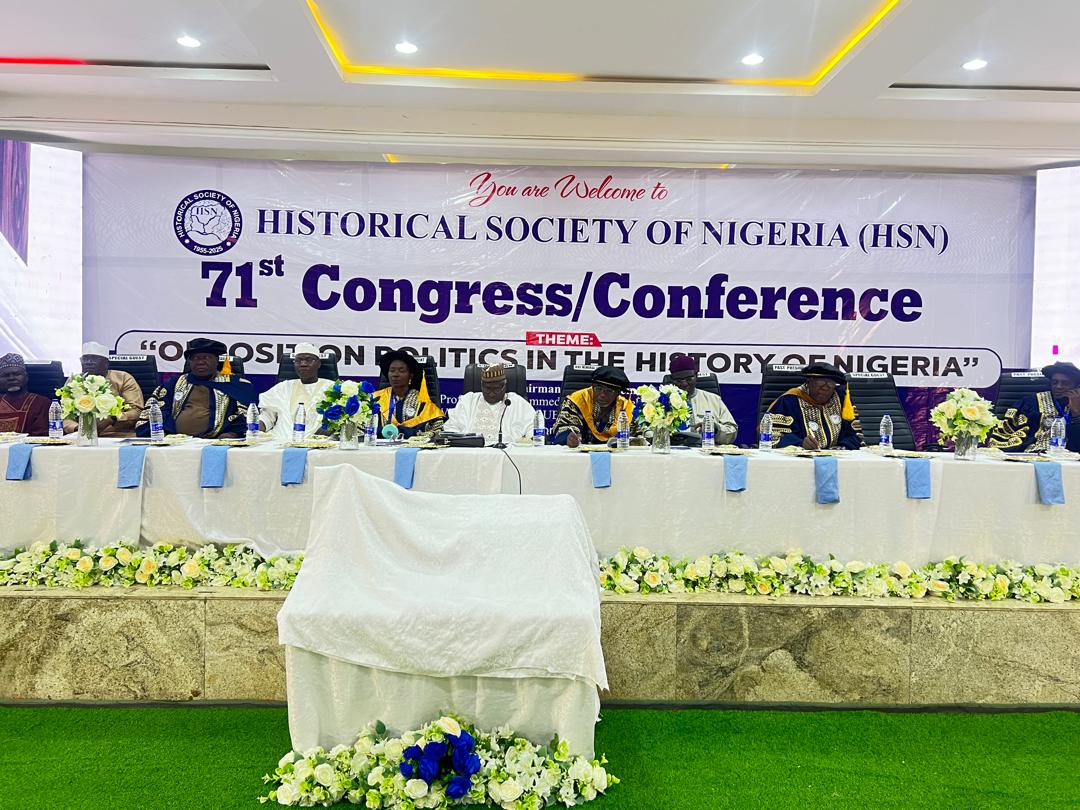
Kwaghe said this at the 71st Annual Conference and Congress of the HSN, in Abuja on Monday, with the theme “Opposition Politics in the History of Nigeria”.
She said the study of opposition politics provided insights into political competition, governance, representation and citizens’ participation in public affairs.
“Opposition is an important feature of a democratic political system.
“Through constructive criticism, alternative policy perspectives, legislative engagement and public debate, opposition political forces can contribute to accountability,” she said.
Kwaghe added that the conference would examine various aspects of opposition politics, including its political economy, the role of women and the legislature in Nigeria’s democracy.
“These include the political economy of opposition politics and democracy in Nigeria, women and opposition politics, the legislature and opposition politics in Nigeria, among several other sub-themes,”she said.
She urged participants to engage actively in the discussions, exchange research findings and share ideas that would deepen understanding of Nigeria’s political history.
In his remarks, the Chairman of the Occasion, Prof. Kyari Mohammed, said opposition was essential to democracy, noting that a government could be benevolent without being democratic.
“There cannot be a democracy without an opposition. That is what makes a democracy democratic,” he said.
Mohammed, a professor of history, said Nigeria’s political history had been shaped by various forms of opposition, including resistance to colonial rule and the activities of nationalist movements that fought for independence.
He noted that opposition parties had remained part of Nigeria’s political experience across different republics.
Mohammed, however, said both ruling parties and opposition groups could undermine democratic processes in their quest for power.
“For you to have any workable democracy, there has to be an opposition.
“The opposition must exist, the opposition must thrive, and there should be differences of opinion, and these differences should be accepted within the normal norms of democracy,” he said.
He expressed hope that Nigeria’s political system would improve, urging authorities to allow opposition forces to operate freely.
In his goodswill message, Former Chief of Army Staff, Lt.-Gen. Tukur Buratai (rtd.), said opposition politics was essential for promoting accountability and strengthening democracy in Nigeria.
“Accountability is not a partisan weapon, but a democratic necessity,” he said.
He said political disagreements should not be regarded as disloyalty, adding that competition conducted within the law and with mutual respect would strengthen the country.
“Disagreement is not disloyalty, and political competition conducted within the bounds of law and civility strengthens rather than weakens the nation,” he said.
He said a stable democracy required a balance between military professionalism and constitutional governance, while urging Nigerians to promote peaceful coexistence.
Prof. Okpeh Okpeh, while delivering the Dike Memorial Lecture, said the late historian, Prof. Kenneth Dike, challenged colonial interpretations of African history by promoting research that highlighted Africans’ contributions to their history and civilisation.
Okpeh said Dike and other historians associated with the Ibadan School of History used oral traditions and archival records to challenge the belief that Africa’s history became meaningful only through European intervention.
“Dike, along with his colleagues, fought against this type of historiography.
“They did this by studying oral tradition as well as archival documents that looked at how Africans shaped their own history rather than Europeans,” he said.
Okpeh said Dike’s scholarship helped provide an intellectual foundation for Nigerian nationalism by challenging colonial accounts of African history.
“Dike and other historians at Ibadan provided one of the intellectual foundations of Nigerian nationalism,” Okpeh said, adding that journalism, education, labour movements and Pan-Africanism also contributed to its growth.
He added that nationalist movements across Africa gained momentum after the Second World War, leading to the struggle for independence from European colonial powers.
“Political independence came with enormous hope, but the reality of the last five to six decades suggests that it has not seriously impacted on African society,” he said.
The scholar called for a deeper understanding of Africa’s historical experiences to explain its political challenges and development.
The News Agency of Nigeria (NAN) reports that awards were presented to several lecturers for their commitment and contributions to the Historical Society of Nigeria, alongside the unveiling of the HSN National and Regional History Competitions for primary and secondary schools. (NAN)