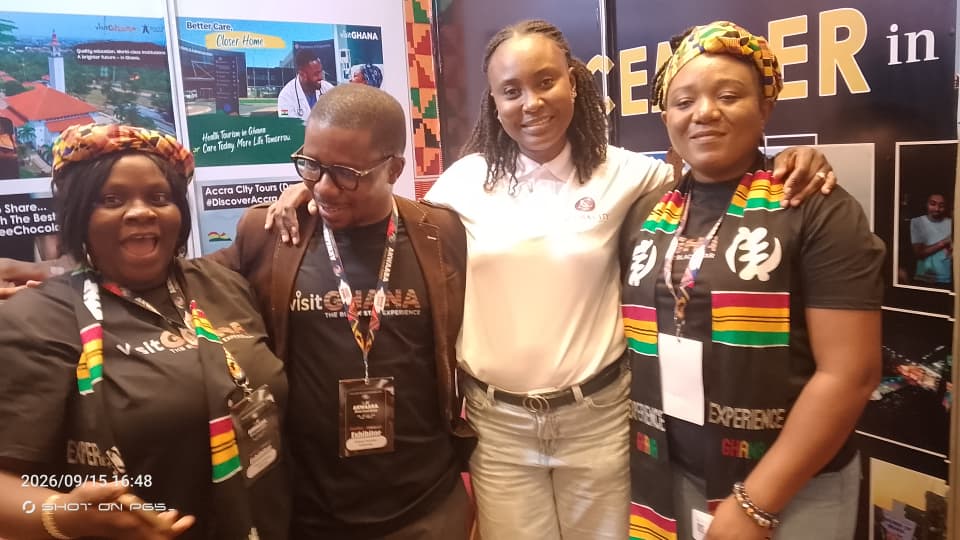
Nigeria is emerging as an increasingly important market for Ghana’s tourism industry, driven by rising arrivals and stronger cross-border business.
Collins Ackwerh, Deputy Director, Product Development, Ghana Tourism Authority (GTA), said Nigeria had become Ghana’s second-largest source market.
Ackwerh spoke with the News Agency of Nigeria (NAN) on the sidelines of the 22nd Akwaaba African Travel Market in Lagos.
He said Ghana received about 82,000 Nigerian visitors in 2023, 111,000 in 2024 and 136,000 in 2025.
Ackwerh said the growth reflected Ghana’s sustained engagement with the Nigerian market and its wider push for cross-border tourism.
“Now Nigeria is our second generating market so it shows you how important Akwaaba Market is to us and then what it has also brought us,” he said.
He said Ghana expected Nigeria to become its leading source market within five to 10 years as targeted marketing increased.
Ackwerh said Ghana had also recorded growth in domestic tourism after an 18-month campaign encouraging Ghanaians to explore their country.
He said the campaign increased domestic tourism figures by more than 23 per cent within a year, with growth continuing.
For Nigerian visitors, he said Ghana was offering more than leisure, with education, medical tourism, adventure, nightlife and other experiences forming part of the pitch.
Describing proximity as an advantage in attracting Nigerian travellers, Ackwerh said Nigeria was only 60 minutes away from Ghana.
He said Ghana was also developing new adventure products, including a one-kilometre zipline, while expanding paragliding and water-based activities.
The growing Nigerian market is also shaping the response of Ghana’s hospitality operators, who are developing products around business, leisure and group travel.
Head of Sales, Labadi Beach Hotel, George Ayisi, said the hotel had established a strong presence in the Nigerian market through its leisure and business offerings.
He said the beachfront hotel combined accommodation with corporate retreats, conferences, team-building activities and leisure experiences.
“Our hotel is predominantly a hotel that is ideal for both leisure and business,” he said.
He said Labadi, which currently has 164 rooms, plans to add 100 rooms and an ultra-modern conference facility, bringing its room stock to 264.
Ayisi said the hotel had also adapted its services to Nigerian visitors, including Nigerian dishes prepared by a Nigerian chef.
He said the hotel served dishes including edikaikong, ogbono and egusi soup, reflecting demand from Nigerians living in Ghana and visiting the country.
Linking the market to cultural tourism, food and wider Ghana-Nigeria connections, he said Nigerian market played a lot of significance and importance.
He also identified MICE – Meetings, Incentives, Conferences and Exhibitions, as an important part of the hotel’s business.
Alisa Hotels Group is also looking to deepen its Nigerian business, though its experience points to a major constraint facing intra-African tourism.
Esperanza Adjei, Group Sales and Marketing Manager, Alisa Hotels Group, said Nigerian travel agents had repeatedly raised concerns about travel costs.
“We see that rate is a significant problem.
“They talk about how it’s cheaper to go international than do intra-Africa because of the prices,” she said.
She said Alisa had responded by reviewing its rates, with Nigerian tour operators receiving more preferred rates than some corporate clients in England.
Adjei said growing inquiries from Nigerian travel agents showed that interest in Ghana remained strong in spite of the cost challenge.
She said the group had been presenting Nigerian travel professionals with packages combining accommodation, transportation and visits to attractions.
She said its Accra property has 235 rooms and suites, aboy 14 conference rooms and a 1,000-capacity dome.
She added that the Tema property had 50 rooms and seven meeting rooms, with its largest meeting facility accommodating up to 400 people.
Adjei said the group had also engaged the National Association of Nigerian Travel Agencies as it sought to grow business from Nigeria.
Similarly, the Acting Sales and Marketing Manager, Accra City Hotel, Frances Arthur, emphasised a broader shift toward packaging accommodation with experiences rather than selling hotel stays alone.
Arthur, who also represented The Peninsula Resort and Golf Club, said Ghana was also packaging travel experiences to make journeys to resort destinations part of the tourism offering.
She said visitors could park at a designated point and continue by speedboat, for experiences including stops at waterfalls, caves and monkey sanctuaries, or enjoy boat cruises, canopy walks, golfing and hiking.
She said the destination had expanded its canopy walk to about 550 metres, adding that continuous improvements and new attractions were key to keeping Ghana relevant.
For Ghana, the rising Nigerian numbers therefore represent more than visitor arrivals. They are also creating a larger market for hotels, tour operators, attractions and other tourism businesses.
At the same time, the concerns raised by Alisa show that demand alone may not guarantee stronger intra-African travel if the cost of reaching destinations remained a barrier.
The challenge for the sector is consequently becoming clearer, converting growing interest from Nigerians into sustained travel by making movement, accommodation and experiences accessible enough to support repeat visits. (NAN)