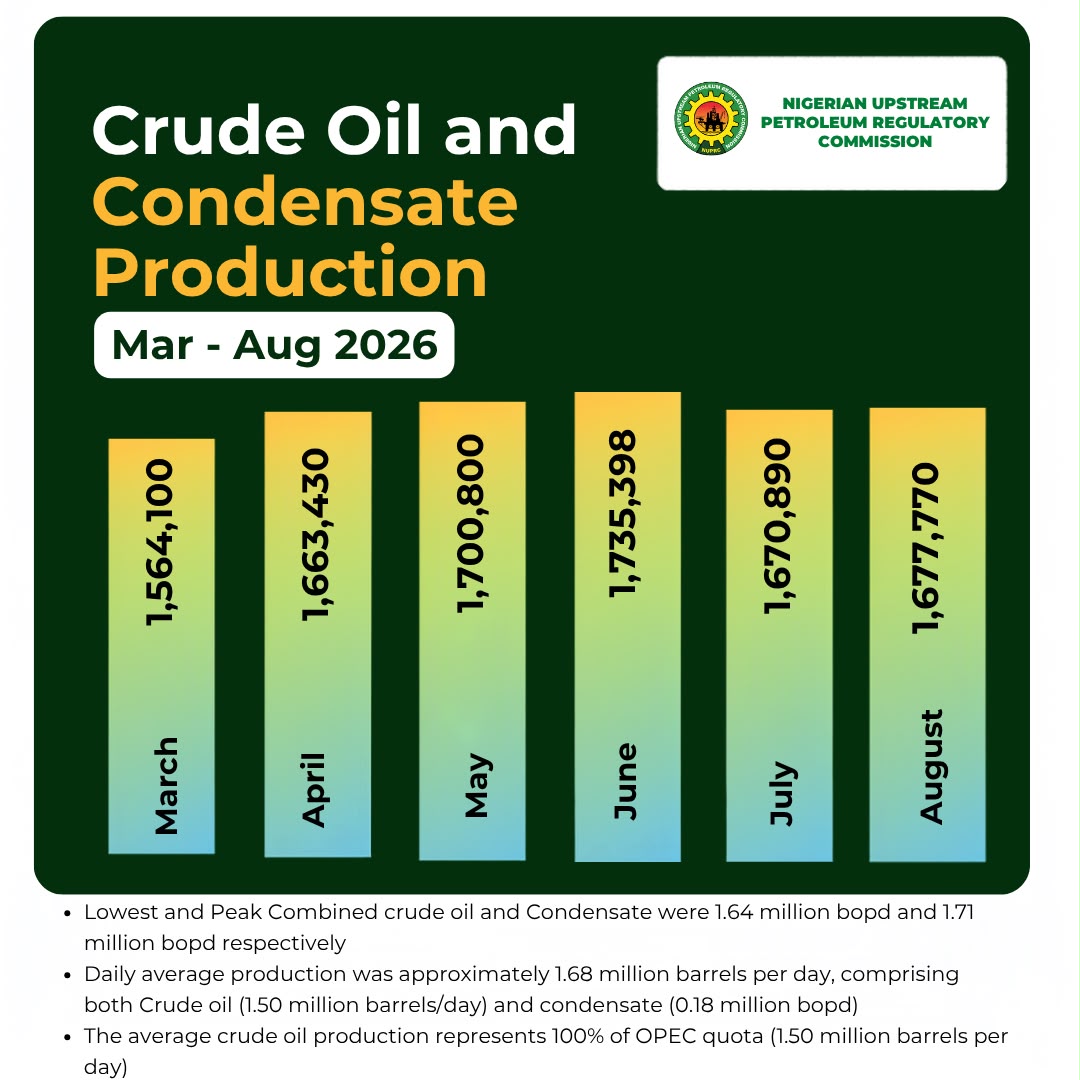
Nigeria’s crude oil and condensate production rose by 0.4 per cent to 1,677,777 barrels per day (bpd) in August 2026.
The Nigeria Upstream Petroleum Regulatory Commission (NUPRC) disclosed this in its crude oil and condensate statistics report released on Sunday.
The commission said crude oil production, excluding condensate, averaged 1,500,190 bpd during the month under review.
It added that Nigeria met its Organisation of Petroleum Exporting Countries (OPEC) crude oil quota for the fourth consecutive month.
According to the report, combined crude oil and condensate production fluctuated between a daily low of 1.64 million barrels and high of 1.71 million barrels.
The report showed that Bonny Terminal recorded the highest average production at 320.04 thousand barrels per day (kbpd).
Forcados Terminal followed closely, recording an average daily production of 317.40 kbpd during the month.
“Qua Iboe Terminal recorded an average production of 171.72kbpd of crude oil and condensates,” the report said.
It added that Escravos Oil Terminal recorded a daily average production of 131.71 kbpd during the period.
Bonga ranked fifth among the highest-producing terminals, with an average output of 92.50 kbpd of crude oil.
The NUPRC attributed the modest increase in August production largely to the resolution of operational challenges involving the Single Buoy Mooring (SBM) at the Erha field.
The commission said the challenges had adversely affected production performance in the preceding month.
It explained that restoring normal evacuation and production operations at the Erha field contributed positively to overall production volumes in August.
“Production activities across most other producing assets remained relatively stable,” the report said.
It said operators continued implementing measures to optimise production efficiency, maintain asset integrity and minimise operational disruptions.
The commission added that routine production and crude evacuation operations were generally sustained across the industry during the period.
“These supported the observed improvement in output,” it said.
The report described the August increase as modest but said it reflected continuing industry efforts to address operational bottlenecks.
It said stakeholders were also working to restore affected production capacity and support sustained growth in the coming months.
The commission said operators remained focused on improving asset reliability and operational resilience across Nigeria’s upstream petroleum sector.
It added that intervention programmes were being advanced to strengthen production performance and reduce disruptions.
The August performance, according to the NUPRC, underscored the importance of resolving operational constraints promptly.
It also highlighted the need for effective asset management and continued collaboration among industry stakeholders.
Such measures, the commission said, remained critical to safeguarding and improving Nigeria’s crude oil production capacity. (NAN)