The United Nations Children’s Fund (UNICEF) and journalists have urged Nigerian media houses to institutionalise stronger child protection and safety policies in the newsrooms.
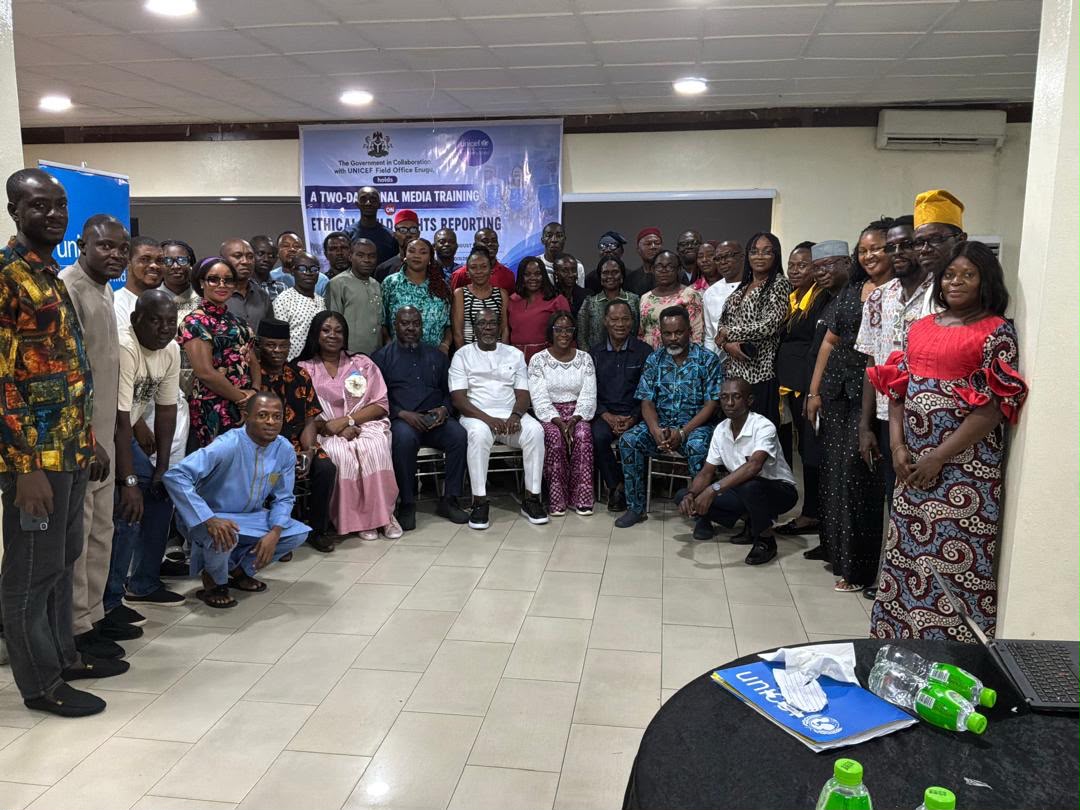
Forty journalists from the North Central, South East and South South zones, made the call in a resolution after a two-day workshop in Port Harcourt to adopt stricter ethical guidelines for reporting children’s issues.
The workshop, organised by UNICEF in partnership with the Child Rights Information Bureau, (CRIB), brought together editors and correspondents from print, broadcast and online media to deliberate on legal, ethical and professional responsibilities in covering children.
The News Agency of Nigeria (NAN) reports that at the end of the workshop, participants in a communique on Saturday, issued a 10-point resolution aimed at safeguarding children in news coverage.
They resolved that journalists must report children’s cases accurately and use terms such as “alleged” or “accused” until guilt is established by a competent court.
The communique also urged media practitioners to avoid graphic, sensational or unnecessary details that could expose children to harm, stigma or exploitation.
The communique stressed the need to give priority to a child’s protection, medical care, psychological well-being and access to justice.
Participants further resolved to avoid interviews that could re-traumatise children and to seek information from appropriate authorities, including the police and recognised child-protection agencies.
They also agreed to disclose any personal relationship or conflict of interest to editors and to focus coverage on child protection, institutional response and accountability rather than details of alleged abuse.
The workshop recommended that media organisations establish dedicated Child Rights Desks to ensure sustained attention to children’s issues, while responsible blogging and online platforms should uphold the same ethical and legal standards as mainstream media.
In further recommendations, participants urged UNICEF to strengthen its strategic partnership with the Nigerian Guild of Editors to sustain responsible coverage.
They also called for the engagement of media owners, publishers and senior management through NPAN and NBC to institutionalise child-sensitive reporting policies across newsrooms.
The participants emphasised the need for media houses to develop and implement internal child-protection and ethical reporting policies.
They advocated regular capacity-building on child rights, trauma-informed journalism, digital safety and the legal framework governing the reporting of children.
Facilitators include Susan Akila of UNICEF; Dr Jide Johnson, Nigerian Institute of Journalism; and Mr Temitoye Falayi, CRIB, Federal Ministry of Information and National Orientation (FMINO).
Others were Dr Geoffrey Njoku, Truevine Communications; Dr Namsel Nimyel, former Excecutive Director, NTA; and Mr Lanre Idowu of DAME.
Ten technical sessions covered child rights, ethical principles, balancing public interest with protection, storytelling that empowers, and legal frameworks.
Participants expressed appreciation to UNICEF, FMINO and CRIB for sponsoring the training, and reaffirmed commitment to journalism that informs, protects and empowers children. L(NAN)