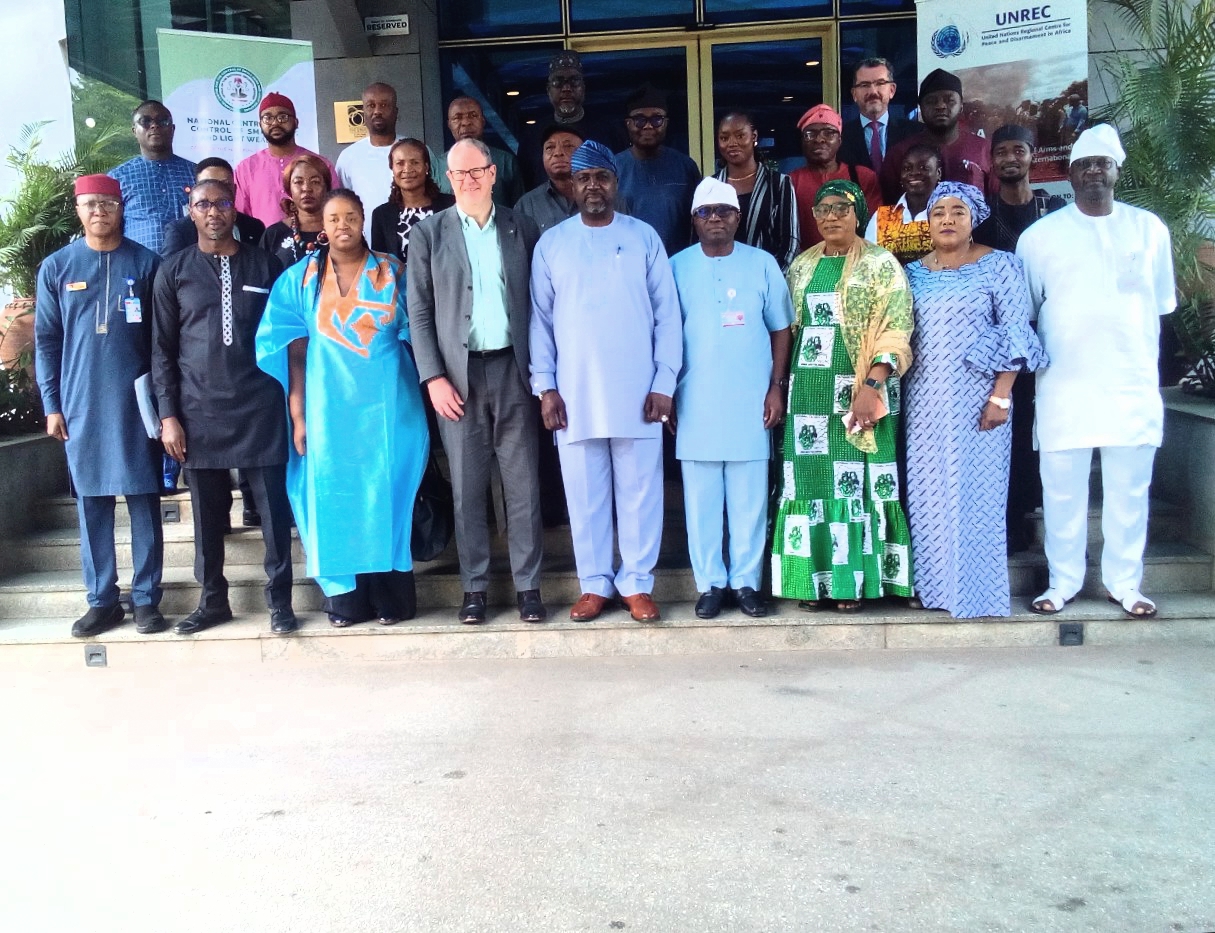
The United Nations Office for Disarmament Affairs (UNODA) and the National Centre for the Control of Small Arms and Light Weapons (NCCSALW) have engaged Nigerian civil society organisations.
The engagement focused on strengthening efforts to combat illicit proliferation of small arms and light weapons through improved collaboration and community participation.
The roundtable, held in Abuja on Friday, brought together UNODA, European Union representatives and civil society organisations.
Speaking at the meeting, Dr Adedeji Ebo, UNODA Director and Deputy High Representative, called for stronger collaboration between government institutions and CSOs.
Ebo said CSOs were uniquely positioned to bridge the gap between government policies and communities affected by illicit arms proliferation.
He said the ongoing national baseline survey on illicit small arms and light weapons would only succeed if CSOs were treated as strategic partners.
According to him, their community-level perspectives must be incorporated into the survey to ensure its findings accurately reflected realities across affected communities.
Ebo, however, urged CSOs to improve coordination and demonstrate their value when engaging government and security institutions.
“Civil society is the bridge between the state and society,” he said, stressing the importance of connecting international arms-control instruments with community realities.
“You have to demonstrate what you bring to the table.
“Just because you say you are a civil society organisation or NGO does not mean doors automatically open. You have to earn that access,” he added.
The Director-General of NCCSALW, retired AIG Johnson Kokumo, described CSOs as critical partners in Nigeria’s fight against illicit arms proliferation.
Representing the National Arms Registrar, retired Maj.-Gen. Bamidele Shafa said CSOs’ proximity to communities provided valuable information on illicit weapons’ drivers and consequences.
He said CSOs would play central roles in designing, validating and disseminating findings from the forthcoming national baseline survey.
The EU Ambassador to Nigeria and ECOWAS, Gautier Mignot, said CSOs were indispensable in bridging national policies and community realities.
Mignot, represented by Ron Hendrix, EU Programme Officer for Migration, Organised Crime and Drugs, outlined several contributions by CSOs.
He listed awareness creation, early warning, conflict prevention, policy advocacy, victim assistance, rehabilitation and reintegration among their key contributions.
Mignot said lasting progress in arms control and disarmament required strong partnerships involving governments, regional bodies, international partners and civil society.
Mariame Camara of the UN Regional Centre for Peace and Disarmament in Africa highlighted funding opportunities available through the United Nations Trust Facility Supporting Cooperation on Arms Regulation (UNSCAR).
Camara said the annual call for proposals opened on July 15 and would close on Aug. 31.
She urged eligible organisations to submit proposals addressing practical challenges affecting arms control and disarmament.
According to her, UNSCAR typically receives about 100 applications annually but funds only between 10 and 15 projects.
She said successful projects could receive grants of up to 100,000 dollars each, while Physical Security and Stockpile Management projects could receive up to 150,000 dollars.
Contributing, CSO representatives called for stronger coordination among civil society organisations to improve their collective impact.
They proposed a joint technical training programme, Civil Society Technical Advisory Group and national small arms data hub.
The proposed initiatives, they said, would strengthen data collection, analysis and policy engagement on illicit arms proliferation.
They also called for institutionalising a technical working committee and decentralising its activities to grassroots communities.
The CSOs identified gender, policy and disability-related gaps as additional challenges requiring greater attention within arms-control efforts.
They also cited porous borders, insecurity, mistrust, inadequate funding and limited technical capacity as major obstacles to effective arms control.
The meeting is expected to strengthen technical cooperation among UNODA, NCCSALW and Nigerian CSOs.
It is also expected to enhance community participation in efforts to prevent illicit arms proliferation and support evidence-based policy responses. (NAN)