President Bola Tinubu has urged African countries to invest in knowledge, institutions and indigenous capabilities to address emerging security threats driven by artificial intelligence, cyber technologies and autonomous systems.
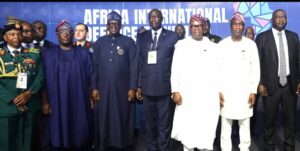
Tinubu made the call at the opening ceremony of the maiden Africa International Defence Exhibition (AFRIDEX) 2026 at Eko Atlantic, Lagos, on Monday.
The president, who was represented by Senate President Godswill Akpabio, said Africa must prepare for the changing character of conflicts in the global society by developing the expertise and institutions required to understand and responsibly deploy emerging technologies.
He said the continent must also develop its own solutions and strengthen local capacity, particularly in the maintenance of defence equipment and systems.
According to him, cyber capabilities, space technologies, artificial intelligence and autonomous systems are transforming the security environment, requiring African countries to adapt their defence strategies.
“Our young people have the talents. Our responsibility is to create the opportunities for them,” he said.
Tinubu said Africa’s security challenges were becoming increasingly complex and interconnected, spanning territorial borders, the Gulf of Guinea, the Sahel, cyberspace and outer space.
He said the threats endangered lives and livelihoods, disrupted trade and weakened the foundations of development across many African countries.
He urged that Africa’s security must therefore command collective attention, because there could be no enduring prosperity where fear governed daily life.
According to Tinubu, Nigeria understands the cost of insecurity, citing the loss of lives, displacement of communities, disruption of livelihoods and denial of economic opportunities.
He commended the armed forces for confronting terrorism, insurgency, banditry, piracy and other transnational threats, while honouring personnel who had paid the supreme sacrifice.
Tinubu said the sacrifices of military personnel imposed an obligation on the government to provide adequate equipment, training, leadership and support.
He added that lasting security required strong institutions, public trust, reliable partnerships and industrial capacity to sustain defence capabilities.
According to him, defence partnerships must deliver lasting benefits beyond the supply of equipment through skills development, knowledge transfer, stronger local industries and improved maintenance capacity.
“Every major acquisition should help develop skills, transfer knowledge, strengthen local industries, deepen our capacity to maintain what we operate.
“The measure of a successful partnership is the capability it leaves behind. African engineers must gain expertise, African enterprises must grow, African institutions must become stronger,” he said.
The president also called for predictable funding, adequate equipment, rigorous training and sustained institutional support for African-led peace operations.
He stressed the need for stronger maritime cooperation to protect the Gulf of Guinea, describing the region as vital to trade, energy security and shared prosperity.
Tinubu said Nigeria was advancing indigenous defence production, strengthening cooperation with trusted partners and developing capabilities to respond to evolving security threats.
He reaffirmed the country’s commitment to ensuring that investments in defence strengthened national capacity and protected citizens, while upholding professionalism, discipline, human rights and democratic civilian authority.
The president urged international partners to support responsible investment, meaningful technology transfer and collaborations that would strengthen African industries and institutions.
He also called on African leaders and defence chiefs to translate discussions at AFRIDEX into joint training, intelligence sharing, stronger defence industries and improved military cooperation.
“Threats that cross borders demand cooperation that crosses borders. We have the people, the resources, the ingenuity to strengthen Africa’s security architecture.
“We must now match these assets with investment. We must coordinate, and we must also exhibit the political will to act decisively in order to bring security to our people,” he said.
Tinubu said the ultimate beneficiaries of the decisions taken at the exhibition should be ordinary citizens, including farmers returning safely from their fields, children learning without fear and traders moving freely across markets.
In his goodwill message, Gov. Babajide Sanwo-Olu of Lagos State said security was fundamental to economic growth, particularly in Lagos.
Sanwo-Olu, who was represented by his Deputy, Dr Obafemi Hamzat said AFRIDEX provided a platform for African and international stakeholders to explore opportunities for cooperation across land, air, sea, space and cyber defence.
He also added that AFRIDEX offered an opportunity to strengthen interoperability, intelligence sharing, training, local production and technology transfer to enable African countries develop their own defence capabilities.
He noted that the increasingly transnational nature of security threats required cooperation among governments, armed forces, industries and policymakers.
The governor said the state was rebuilding its Command and Control Centre and expanding closed-circuit television coverage to strengthen security coordination and surveillance.
“We have learnt that modern security rests on technology, coordination and public trust, as much as on personnel,” he said.
Earlier, the Director-General of the Defence Industries Corporation of Nigeria (DICON), Maj.-Gen. Ibrahim Alaya, described AFRIDEX as a strategic platform for strengthening Africa’s defence capabilities, advancing technological innovation and building a more secure and self-reliant continent.
He noted that DICON, established in 1964 to manufacture military hardware for the Nigerian Armed Forces and security agencies, had received renewed impetus through the DICON Act 2023, signed into law by the President.
According to him, the legislation provides a framework for repositioning the corporation and developing Nigeria’s military-industrial complex.
” It also creates opportunities for partnerships with local and international defence industries, technology providers and research institutions.”
Alaya added that AFRIDEX was designed to showcase defense technologies across land, air, maritime, space and cyber domains, attract investment, facilitate knowledge exchange and strengthen industrial partnerships.
He stressed that the exhibition’s success would ultimately be measured by lasting partnerships, investments, industrial projects and sustainable indigenous capabilities.
The News Agency of Nigeria (NAN) reports that the exhibition brought together African chiefs of defence staff, security agencies, global manufacturers and procurement leaders to discuss security challenges, showcase technologies and strengthen partnerships.