Breast Cancer: Kwara governor’s wife urges early detection
Screening
The Wife of Kwara Governor, Mrs Olufolake Abdulrazaq, on Wednesday reiterated early detection as critical to successful treatment of breast cancer.
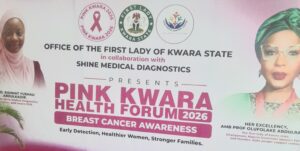
The governor’s wife said this in Ilorin during the Pink Kwara Health Forum, which offered free breast cancer screening to 1,000 women.
The News Agency of Nigeria (NAN) reports the campaign was organised in collaboration with the Office of the Wife of the Governor, the Ajike People Support Centre, and SHINE Medical Diagnostics.
The campaign aimed to promote awareness, encourage early detection, and expand access to breast screening.
Abdulrazaq commended the state governor for sustained healthcare investments, including the ongoing Abdulsamad Rabiu Oncology Centre and free screening outreaches across the state’s 16 Local Government Areas.
The governor’s wife, also the founder of the Ajike People Support Centre, said the centre has continued to support cancer patients financially.
“The centre recently flagged off the 2026 Kwara State Cancer Awareness Programme across the three senatorial districts.
“We also recently partnered with BIO Ventures for Global Health to provide highly subsidised cancer medicines for patients under the Kwara Health Insurance Agency,” she said.
She urged residents and community leaders to take advantage of the screening opportunity for comprehensive care that supports patients’ physical and emotional well-being.
Hajiya Ramat Abdulkadir, a radiologist and founder of SHINE Medical Diagnostics, said her passion for the breast cancer awareness campaign was due to the loss of her grandmother to breast cancer.
“Growing up, breast cancer was not new to me, but there is a difference between hearing about something and experiencing its impact first-hand.
“I was young, but I remember how she suffered. I remember how fragile she became.
“Years later, I developed breast pain myself, and I still remember telling my mum and how we visited the doctor together at the hospital.
“I had the opportunity to express my fears, and for once, someone actually listened to me and educated me more about it. That experience shaped me,” she said.
Abdulkadir said that beyond her personal experience, the bigger motivation was that many women still lacked the information they needed about breast cancer.
“Many are afraid to speak about changes in their breasts. Some will not seek medical advice, while others face financial, geographical, and other barriers that make treatment and care difficult to access.
“That is why our vision is to make care more accessible so that common circumstances do not become a barrier to health,” she said.
Prof. Olayide Agodirin, the event’s guest speaker and a consultant surgeon at the University of Ilorin Teaching Hospital (UlTH), explained that breast cancer presents itself in five stages.
“We have Stage 0, Stage 1, Stage 2, Stage 3, and Stage 4.
“Stage 0 is the silent stage. At this stage, cancer is already present in the breast, but the person cannot see it, cannot feel it, and cannot touch it, except through screening.
“It can remain like that in the breast for 3, 5, 6, even 7 years.
“This is the best time to treat breast cancer. At this stage, it can be completely cured without losing the breast, and it is much easier to treat,” he said.
According to Agodirin, at Stage 1, cancer has grown a little, like a small grain.
“At Stage 2, the cancer is a little bigger and begins to spread out of the breast into the surrounding area.
“Stage 3 of breast cancer is when the lump has now taken over the breast. At this stage, the patient may begin to feel pain.
“So, at this stage, the woman herself can look and see that something is wrong.
“Finally, Stage 4, when we are not really talking about curing anymore, because the cancer is no longer only in the breast. It can be in the bone, brain, lungs, or all over the body,” he said.
While educating on self-screening, Mrs Juliet Adeshina, Deputy Director of Nursing, UITH, said breast screening helps to detect the disease before it causes problems.
Adeshina encouraged self-breast examination, followed by clinical examination and then test investigations like ultrasound and mammogram.
“Self-breast examination is looking at and checking your breast by yourself so that you will detect any abnormality on time for prompt treatment.
“Before you start examining your breast, you have to know what your breast normally looks like.
“You should do it three to five days after your period. At that time, the breast is soft and not painful.
“For our mothers who no longer see their period, just pick a fixed day every month. For example, on the first day of every month,” she said. (NAN)