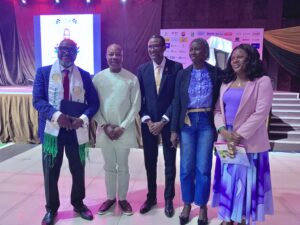
L-R: Mr Owolabi Ayoola, Chairman Nigerian Institute of Building, Lagos Chapter; Dr Segun Obayendo, President, Chartered Institute of Transport Administration of Nigeria; Mr Mubarak Gbaja-Biamila, Chairman Local Organising Committee; and others at the institute’s 35th Buliders’ Conference in Lagos on Wednesday
The Nigerian Institute of Building (NIOB) has called for accelerated digitalisation of construction processes to improve transparency, value, quality and sustainability in Nigeria’s built environment.
The President of NIOB, Mr Bimbo Kolade, made the call at the 35th Lagos Builders’ Conference with the theme: “Smart Building Processes in the Digital Age: Procurement, Monitoring, Control and Quality Management for Sustainable Construction”.
Kolade said digital tools such as Building Information Modelling and drones, as well as digital project monitoring, data analysis and automated quality control systems, could improve construction efficiency, transparency, safety and quality.
He, however, said technology alone could not guarantee successful project delivery, stressing the need for competent professionals, effective procurement systems, proper supervision, regulatory compliance and strong ethical standards.
According to him, professionals must ensure that digital transformation translates into better project delivery and a more sustainable built environment.
The NIOB president said the conference provided an opportunity for stakeholders to examine emerging technologies and identify practical solutions to improve construction practice in Lagos and across Nigeria.
In a keynote address, Dr Segun Obayendo, President, Chartered Institute of Transport Administration of Nigeria, said the future of construction was not merely about building smarter structures, but also about creating smarter building processes.
Obayendo, who is also Technical Adviser to Vice President Kashim Shettima on Transportation, Logistics and Innovation, said data should become a fourth pillar of construction alongside people, materials and methods.
He said the industry was moving from drawings to digital models, paper-based workflows to digital processes, periodic reports to real-time information, and reactive management to predictive control.
According to him, technology should serve as a means of achieving better, accurate and precise decisions in construction.
Obayendo said smart procurement should move beyond selecting the cheapest option to securing the best value over the life cycle of an asset.
He said digital systems should make it possible to trace critical materials and systems from specification and supplier selection through purchase, delivery and inspection to installation, testing and approval.
He also advocated continuous digital monitoring of construction projects using drones, 360-degree cameras, laser scanning, sensors, cloud platforms and Artificial Intelligence.
Obayendo said the tools could provide management with visibility of project costs, programmes, procurement, quality, safety, risks and changes, enabling earlier intervention.
He said quality should be built into every stage of construction rather than treated as something to be inspected at the end.
On sustainability, Obayendo said stakeholders should measure factors including energy, water, waste, materials, carbon emissions, indoor environmental quality, maintenance and life-cycle cost.
He said the transformation was particularly important for Nigeria because of its expanding cities, housing needs and infrastructure requirements.
“Nigeria must not simply consume these technologies. We must develop the capability to use them intelligently for our own environment,” he said.
He, however, said digital transformation required standards, skills, professionalism, reliable data, interoperability and leadership.
Dr Oluyinka Olumide, Lagos State Commissioner for Physical Planning and Urban Development, who represented Gov. Babajide Sanwo-Olu, said embracing smart building processes was no longer an option but an imperative.
Olumide said integrating digital tools into procurement, real-time monitoring, control and quality management was critical to achieving cost efficiency, safety, transparency and sustainability in construction.
He called for stronger collaboration among built-environment professionals and adoption of e-planning permits and e-construction monitoring systems across Lagos State.
Mrs Florence Gbaye, General Manager, Lagos State Building Control Agency, said the agency had adopted a digital platform for approval processes, enabling developers and professionals to submit applications and track them digitally.
Gbaye said the platform had improved accountability and reduced the need for physical interaction in processing approvals, while stressing the importance of verifying documents submitted electronically.
Mr Owolabi Ayoola, Chairman of NIOB Lagos State Chapter, said the chapter had introduced a digital online process for builders’ document authentication, incorporating a digitally-generated Quick Responce (QR) code to enhance verification, traceability and accountability.
Ayoola called for collaboration among governments and regulatory agencies, professionals, developers, contractors, consultants and other stakeholders to establish stronger standards and improve construction processes.
He said sustainable construction should focus on quality, resource efficiency, value for money, safety, durability and long-term performance.
The two-day conference, which began on Wednesday will feature technical sessions and exhibition of businesses and products in the built environment. (NAN)