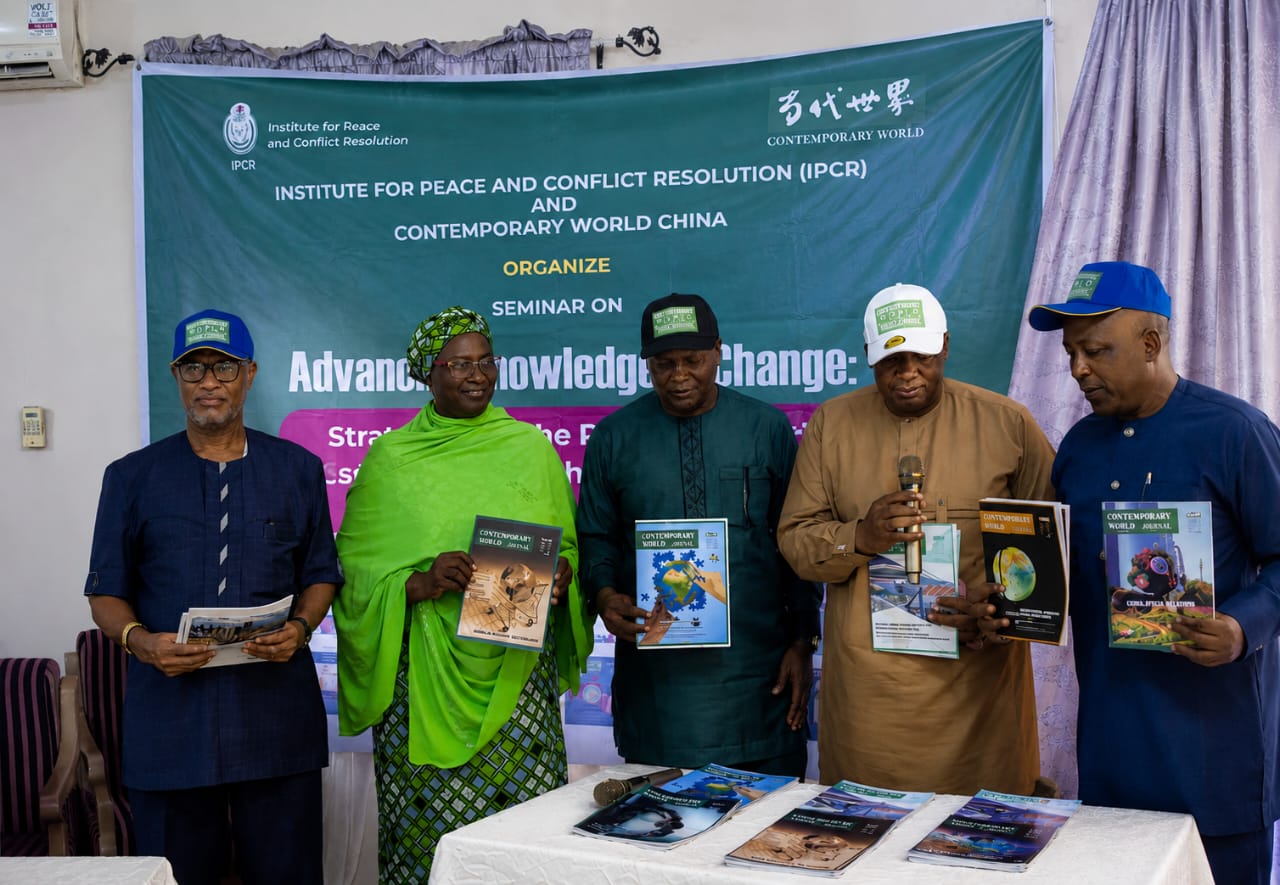
Scholars at Modibbo Adama University (MAU), Yola, have urged China to promote technology and knowledge transfer to strengthen local manufacturing in Nigeria.
The scholars made the call on Friday in Yola at a seminar organised by the Institute for Peace and Conflict Resolution (IPCR) in partnership with Contemporary World Nigeria magazine.
The seminar, themed “Bridging Africa-China Dialogue Through Scholarly Exchange,” was part of IPCR’s Advancing Knowledge Exchange Seminar Series across Africa.
The Deputy Vice-Chancellor (Academics), Prof. Iliya Audu, commended the initiative for promoting academic dialogue on issues affecting Nigeria, Africa and the wider world.
Audu said scholarly exchanges should facilitate knowledge sharing and help address global challenges, including climate change, food security and conflicts.
Delivering the keynote lecture, Dr Ubale Jibrin, an Assistant Professor of International Relations, discussed opportunities for research collaboration between African and Chinese scholars.
Jibrin identified “knowledge diplomacy” as a strategic tool for strengthening Africa-China relations through scholarly exchange, innovation and academic mobility.
He said partnerships should promote higher education and joint research to address food security, public health and climate change.
Jibrin advocated equitable partnerships that would transform African institutions from recipients of knowledge into active producers contributing to sustainable development.
Prof. Abraham Okolo, a former Deputy Vice-Chancellor of MAU, questioned the sincerity of some aspects of Nigeria-China cooperation, particularly technology transfer and technical expertise.
Okolo said Nigeria should develop its technological capacity through skills acquisition, research and industrialisation rather than depend solely on foreign countries.
“Technology is never transferred. If you are waiting for the Western world to advance the African continent technologically, I don’t think we will be technologically advanced,” he said.
He advocated establishing training centres across the country’s geopolitical zones where graduates could acquire practical skills and become producers rather than consumers.
Okolo also proposed sending Nigerian graduates to China for short-term technical training before returning to contribute to the local economy.
Dr Madi Abba, Head, Department of Political Science, said China’s engagement with Africa had produced visible development benefits.
Abba urged Nigeria to seek technology and knowledge transfer from China, particularly in areas where its large market could support local manufacturing.
“Nigerians should study China’s development experience and negotiate partnerships promoting technology acquisition, skills development and local production,” he said.
He called on China to establish skills-training centres across the geopolitical zones to equip young people with practical skills and address youth unemployment.
Abba warned that failure to tackle graduate unemployment could worsen social instability, stressing the need to build a knowledge-based economy.
Dr Jamila Suleiman, Head, Adamawa State Peace Commission, urged scholars not to allow the power imbalance between Africa and China to discourage engagement.
“We should not let that asymmetry diminish the opportunities that exist to create relationships and bridges. What we should actually aim at is creating strategic partnerships,” she said.
Earlier, Dr Joseph Ochogwu, Director-General, IPCR, represented by Dr Olalekan Babatunde, Coordinator, Editorial, Contemporary World Nigeria magazine, emphasised the need for Nigeria to adopt strategic approaches to bilateral and multilateral relations.
He said such strategies would enable Nigeria to maximise the benefits of its international relationships across various sectors.
Babatunde said Contemporary World Nigeria magazine was established to promote scholarly dialogue among African, Chinese and international researchers.
He said the publication also aimed to raise public awareness and promote strategic policymaking through scholarly engagement.
“The quarterly publication, launched in Abuja in 2022, accepts research contributions of about 3,000 words.
“Published articles attract honoraria after undergoing peer review,” he said.
Babatunde urged Nigerian scholars to contribute research offering practical solutions to climate change, food security, public health, insecurity and youth unemployment.
The News Agency of Nigeria (NAN) reports that the event brought together academics, journalists and civil society representatives.
Highlights included the presentation of copies of Contemporary World Nigeria magazine to the university management. (NAN) www.nannews.ng