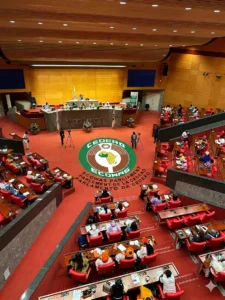
The ECOWAS Parliament has called for the harmonisation of regional customs procedures, import regulations, taxation policies, and business registration requirements, to enhance West Africa’s Micro, Small and Medium Enterprises (MSMEs) growth.
The parliament made the appeal in a resolution following a weeklong delocalised meeting of its joint committee in Cotonou, themed: “Empowering MSMEs as Formal Drivers of ECOWAS Regional Value Chains”.
The News Agency of Nigeria (NAN) reports that the joint committee comprises Industry and Private Sector; Macroeconomic Policy and Economic Research; Administration, Finance and Budget; and Public Accounts.
Co-Chairman of the Committee, MP Alhagie Darbo, who read the resolution, said that to achieve this goal, member states must fully implement the ECOWAS trade and investment protocols.
Darbo said they must also eliminate non-tariff barriers, invest in trade-supporting infrastructure, and strengthen national monitoring mechanisms to improve the business environment.
The lawmakers also recommended the adoption of legal, regulatory, and fiscal frameworks to promote entrepreneurship, support transition of informal enterprises into the formal economy, encourage local value addition, and enhance MSME competitiveness.
“We must improve market governance and protection of traders by ensuring transparent allocation and management of market facilities, providing accessible tenancy agreements, reviewing restrictive trading practices, and addressing unlawful harassment of traders.
“We must expand financial inclusion initiatives and access to affordable finance, particularly for women-owned and youth-led MSMEs, to improve productivity and participation in regional value chains,” they said.
The parliamentarians further urged the ECOWAS Commission to strengthen ECOWAS’ MSME Development Policy (2021–2030) implementation through enterprise support centres, business support programmes, entrepreneurship development initiatives, and digital skills enhancement.
They also urged the commission to establish and strengthen export support and assistance mechanisms along major trade
corridors and strategic border points.
According to them, this will provide guidance to exporters, facilitate compliance with trade requirements, and reduce administrative bottlenecks affecting intra-regional trade.
“We must accelerate the harmonisation and implementation of ECOWAS product standards, certification, and quality assurance mechanisms to ensure consistent requirements for goods traded across member states and enhance access to regional and continental markets.
“Member states must strengthen the implementation of the ECOWAS Trade Liberalisation Scheme (ETLS) and related trade facilitation initiatives by simplifying procedures, improving awareness among businesses, eliminating non-tariff barriers, and enhancing transparency in cross-border trade processes.
“They must facilitate regional value chain development by encouraging industries to source semi-processed raw materials and intermediate inputs from within the Community, thereby reducing dependence on extra-regional imports and strengthening industrial integration.”
The MPs also supported the development of inclusive industrial and agricultural clusters, including producer networks and value-chain platforms, to attract investment, improve productivity, facilitate access to finance, and enhance the competitiveness of regional enterprises.
They urged the ECOWAS Bank for Investment and Development (EBID) to expand access to affordable and tailored financing for MSMEs.
According to them, this should be done through innovative financing mechanisms, including credit guarantee schemes, concessional financing windows, and risk-sharing instruments targeting women and youth-led enterprises.
They urged member states to support investment in regional industrial and agricultural clusters by developing financing instruments that enable producers and actors on the value-chain to expand production capacity and integrate into regional markets.
The lawmakers stressed the need to strengthen their oversight and advocacy for the implementation of ECOWAS trade, investment, industrialisation, and MSME development frameworks by monitoring states’ compliance with Community instruments.
They also pledged to promote stronger political commitment among member states towards ECOWAS protocols and policies implementation aimed at improving market access, industrial development, and regional economic integration.
The resolution also included their decision to transmit the recommendations of the Joint Committee meeting to all relevant ECOWAS institutions, as well as scale advocacy at the national level.(NAN)