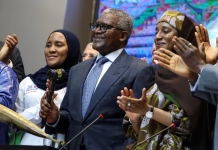
The Federal Government and development partners have validated the draft Special Agro-Industrial Processing Zones (SAPZ) policy to accelerate agro-industrial development, attract $4.4 billion investment and create jobs.
Dr Kabir Yusuf, National Programme Coordinator, SAPZ, said this at the stakeholder validation workshop on the draft policy in Abuja on Monday.
He said the validation was a major milestone towards establishing a framework for planning, developing, regulating and sustaining SAPZ across the country.
The workshop, themed “Facilitating Seamless Investment Entry and Operations in Nigeria’s Special Agro-Industrial Processing Zones,” brought together key stakeholders to review the policy.
Yusuf said the policy would strengthen agricultural value addition, promote exports, improve food security and attract private sector investment into the sector.
He identified SAPZ as an “institutional glue” needed to transform agriculture from subsistence farming into a bankable industrial enterprise.
“The policy was conceived not as another agricultural programme, but as an industrialisation programme anchored on agriculture,” Yusuf said.
He added that SAPZ would harmonise existing agricultural, industrial, trade, investment and special economic zone policies rather than replace them.
Yusuf said Phase One of the programme covers seven states and the Federal Capital Territory, with plans to expand nationwide.
He added that the project has an economic internal rate of return of 30.85 per cent and financial return of 30.71 per cent.
Yusuf said SAPZ would require collaboration among over 20 Federal Government ministries, departments and agencies, state governments and private investors.
He quoted the Minister of Agriculture and Food Security, Sen. Abubakar Kyari, as saying Nigeria’s annual food import bill of over $10 billion was unsustainable.
According to him, Kyari compared the food import bill with agro-export earnings of less than $400 million, attributing the disparity to weak supply chains and infrastructure deficits.
Yusuf said 30 to 60 per cent of farm produce is lost after harvest, costing the country between $9 billion and $10 billion annually.
“Without roads, power, processing capacity, financing and market access, agricultural produce remains a low-value commodity. SAPZ exists to close that gap,” he said.
Earlier, Mrs Dede Ekoue, Country Director, International Fund for Agricultural Development (IFAD), said an effective SAPZ policy should promote seamless investment and inclusive growth.
Ekoue said smallholder farmers should be treated as key actors in agro-industrialisation and not only beneficiaries of the programme.
She added that IFAD was supporting smallholders, women, youth and rural enterprises through SAPZ to improve productivity, resilience, technology access and markets.
Ekoue said partnerships among the African Development Bank, Islamic Development Bank and private sector would be critical to SAPZ success.
(NAN)