Gov. Caleb Mutfwang of Plateau says the state aims to become Nigeria’s industrial processing hub within the next three years.
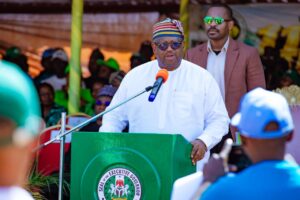
Mutfwang made the pledge on Wednesday while declaring open the 11th National Trade Fair in Jos, with the theme ‘Harnessing Agriculture and Livestock Value Chains for Food Security, Job Creation and Shared Prosperity’.
He said his administration was investing in infrastructure, industrial revival, livestock development and agricultural processing to restore Plateau’s former commercial prominence.
“Our target is that, by the grace of God, in the next two to three years, Plateau is going to become an industrial processing hub in Nigeria,” he said.
The governor disclosed that he had secured a memorandum of understanding with Chinese investors to establish an industrial park in the state.
“I just returned from China last week, where we have entered into a memorandum with Chinese investors who are coming to build an industrial park,” he said.
He explained that the proposed facility would accommodate numerous trailers and provide access for manufacturers across the state.
Mutfwang said the initiative formed part of broader efforts to create economic opportunities for young people and attract investment.
He urged investors, manufacturers and other stakeholders to partner with the government in achieving the state’s industrialisation objectives.
The governor said his administration was also working to revive moribund industries and strengthen the livestock and agricultural value chains.
He disclosed that Hill Station Hotel had resumed operations, while efforts were underway to restore Plateau Hotel.
“We are also rebuilding a brand new abattoir that will slaughter 500 cows a day,” he said.
According to him, the facility will support the development of the livestock economy as a major source of prosperity for Plateau residents.
Mutfwang added that his administration was promoting the cultivation and processing of Plateau potatoes to serve Nigerian and international markets.
He said the initiatives were intended to rebuild the state’s commercial base and create sustainable economic opportunities.
Reflecting on Plateau’s commercial history, the governor said the state was reportedly home to Nigeria’s second chamber of commerce after Lagos.
“That tells a lot; it means that Plateau has always been a place to be reckoned with commercially,” he said.
He also recalled that Plateau had attracted a large European population outside Lagos from 1960 onwards, reflecting its historical commercial significance.
Mutfwang said the government was determined to restore the state’s position as a major commercial centre through strategic investments and an improved business environment.
He urged business owners to maintain high standards while the government worked to create conditions that would enable enterprises to thrive.
Earlier, the Commissioner for Commerce and Industry, Mr Musa Ashoms, called on investors, farmers, manufacturers and entrepreneurs to support the state’s economic development drive.
Ashoms said Plateau possessed abundant agricultural resources, a vibrant entrepreneurial population and a strategic position for food production and distribution.
“Our challenge is to connect these advantages to investment, modern technology, agro-processing, livestock development and sustainable markets,” he said.
He said economic prosperity depended not only on production but also on the value created and shared across communities.
The commissioner added that the government recognised the importance of stronger public-private partnerships and support for small and medium-sized enterprises.
“I therefore invite investors, manufacturers, farmers and entrepreneurs to see Plateau not only as merely a destination for trade, but as a partner in enterprise and a place of opportunities,” he said.
Ashoms urged participants to use the trade fair to establish partnerships, attract investments and translate the state’s productive potential into tangible benefits for residents. (NAN)