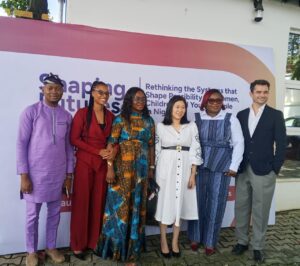
Adenike Aloba, IFI’s Executive Director and a Luminate official, at unveiling of knowledge products of IFI on Friday in Abuja.
Technology
Inclusive Futures Initiative (IFI), a Non Governmental Organization (NGO) says digital technology can improve the monitoring of rights violations, strengthen the enforcement of existing laws and connect victims with legal assistance and other support services.
IFI’s position is contained in a report titled ‘Mapping the Women and Children’s Rights Ecosystem in Nigeria’ which was presented by its Executive Director (E.D), Lucy Okonkwo, at the unveiling of the organisation’s knowledge products on Friday in Abuja.
The News Agency of Nigeria (NAN) reports that an ecosystem intelligence map, with support from Luminate Group is also one of the products in the report.
The products provide evidence-based insights to guide targeted interventions addressing challenges affecting the groups.
The E.D said that civic technology, data-driven advocacy and community engagement could help address gaps in protecting women and children against abuse and exploitation.
Okonkowo said the report identified child marriage, female genital mutilation (FGM), child labour, gender-based violence and digital exploitation as major challenges affecting women and children in Nigeria.
She noted that despite the existence of several laws and active civil society organisations, inconsistencies in the legal framework and gaps in implementation continued to undermine the protection of their rights.
She explained that the report also identified the Child’s Rights Act, 2003, and the Violence Against Persons (Prohibition) Act, 2015, among the key laws designed to protect vulnerable groups.
However, the E.D noted that the differences in the application of laws across states and sociocultural practices continued to pose challenges to effective enforcement.
Okonkwo said according to the report, an estimated 20 million women and girls in Nigeria have undergone Female Genital Mutilation (FGM), while 24.6 million children aged five to 17 are engaged in child labour.
She also noted that an estimated 24 million girls and women were married before the age of 18 based on the report.
Okonkwo further highlighted digital exploitation and image-based sexual abuse as emerging threats, noting that advances in artificial intelligence and its integration into social media had created additional vulnerabilities for women and children.
To address the challenges, she said it recommended an integrated data system linking the National Human Rights Commission (NHRC), the National Agency for the Prohibition of Trafficking in Persons (NAPTIP), sexual assault referral centres, state ministries and civil society organisations.
She said the proposed system, with appropriate privacy safeguards, would facilitate the monitoring of rights violations, help identify areas with high incidences of abuse and guide the allocation of resources.
Okonkwo also recommended mobile and web-based platforms to help parents identify rights violations, report cases, access legal assistance and document incidents of abuse.
She advocated community-based data collection involving health workers, teachers and local leaders, supported by secure digital applications to improve information gathering and strengthen advocacy.
Speaking at the event, IFI’s Board Member, Adenike Aloba, said the knowledge products unveiled were designed to make the relationships among issues, policies, investments, actors and interventions more visible.
Aloba said this was aimed at providing stakeholders with evidence to make informed decisions and identify opportunities for collective action.
“We want to provide a stronger evidence base for asking better questions, making better decisions, and finding opportunities to act together,” she said.
Melanie Hui, Chief Executive Officer of Luminate Group, reaffirmed the organisation’s commitment to collaborating with groups addressing digital rights violations across various regions.
She said supporting IFI offered an opportunity to shape a digital future that reflected the needs, hopes and aspirations of the communities served by the organisations.
In her keynote address, Luminate Regional Director, Toyin Akinniyi, called for stronger institutions, adequate funding and coordinated interventions to ensure that laws and policies translated into meaningful protection for women and children.(NAN)