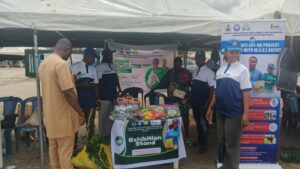
World Food Day: LIFE-ND Programme stand displaying fresh vegetables, pepper, palm oil among other items produced by youth group from, Agbor, Ika South Local Government Area of Delta on Friday in Asaba
Food
Delta Government says it is collaborating with the Federal Government, LIFE-ND Project, FADAMA lll and the Agricultural Development Programmes (ADPs) to train and empower youths and women in various areas of agriculture.
Delta Gov. Sheriff Oborevwori stated this while declaring open the event to mark the 2026 World Food Day, with the theme, “Innovate today. Nourish tomorrow” in Asaba on Friday.
The governor, represented by the Commissioner for Technical Education, Mr Smart Ufoh, said “World Food Day was observed yearly on Oct. 16, to commemorate the establishment of the Food and Agriculture Organisation of the United Nations (FAO) in 1945.
“It provides an important opportunity to reflect on food security, nutrition,
sustainable agriculture and the shared responsibility of ensuring that everyone can access safe and nutritious food.
“The theme calls attention to the role of science, technology, innovation and
traditional knowledge in building agrifood systems that are more efficient, inclusive, resilient and sustainable.
“It reminds us that innovation must translate into practical solutions that reach farmers, producers, processors, traders and consumers.
“Our state possesses significant
agricultural, livestock and fisheries potential, and our task is to convert this potential into increased production, better livelihoods, stronger value chains and greater food security”.
The governor said that agriculture had become a central part of the state economic diversification agenda which was why it became strategic issue at the recently concluded Delta State
Economic and Investment Summit 2026.
“The summit with theme “Harnessing Our Strengths, Unlocking Our Potentials,” reaffirmed the need to diversify the state economy and reduce dependence on a single source of revenue.
“Agriculture and livestock development featured as a dedicated investment area
alongside other strategic sectors.
“We are therefore strengthening agriculture across the value chain, from land preparation and production to processing, storage, marketing and investment.
“In this regard, about 12,000 hectares of land have been mapped for agricultural investment.
“A 100 million dollar investment support fund has been announced as a Viability Gap Fund to help reduce investment risks and support the development of bankable projects,” Oborevwori said.
He said the state government had intervened in various areas to empower small holder famers across the state.
According to him, the intervention is intended to support productivity and strengthen food production at
smallholder farmers cultivating less than 0.5 hectares of priority food crops in the state.
Oborevwori said 5,040 smallholder farmers received four bags of each from the 20,160 bags of fertilizers distributed under the State’s fertilizer intervention.
He said government would continue to support famers to create
opportunities for the people to ensure that the state’s agricultural potential translated into productive.
Earlier, the Commissioner for Agriculture and Natural Resources, Mr Val Arenyeka, said the year’s theme highlighted transformative role of innovation in technology and science, policy solutions, entrepreneurship, education and traditional knowledge in ensuring food security.
He said government had also supported civil servants to maintain homestead farming, encourage dry-season, among other intervention to reduce costs and improve yield, irrigation initiatives and tractor hire services in the state.
“In order to empower our farmers and youths for increased food production, the state government is working in collaboration with the Federal Government, through the LIFE-ND programmes, FADAMA lll and collaborate training the ADPs.
“This collaboration has empowered many various areas of crops, livestocks, fish farming and processing,” Arenyeka said.
He enjoined farmers to engage in climate smart agriculture through cultivation of crops with short gestation and adopt irrigation where necessary, adding that climate change has negatively impacted traditional cropping season.
“The ministry is working with State Emergency Management Agency (SEMA) and the Climate Change Committee in ensuring that measures are out in place against any impeding flooding,’ Arenyeka said
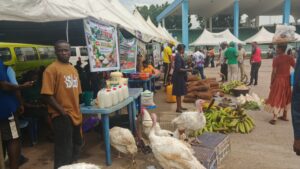
The News Agency of Nigeria (NAN) reports that the event offered residents opportunity to buy and stock up food items ranging from livestocks, crops, palm oil, fish, honey, other items displayed at an affordable rates.
Also, prizes were presented to farmers/ vendors with the best exhibition at the event. (NAN).