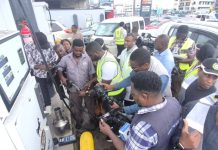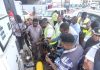
President Bola Tinubu has backed measures to cushion Nigerians against global oil price shocks, including the Nigerian National Petroleum Company Limited’s (NNPCL) decision to forgo its petrol retail profit margin.
Under the arrangement, NNPC Retail will sell petrol at cost within the next 30 days, particularly to support vulnerable households and commercial transport operators.
This means that if the company’s landing cost is N1,300 per litre, it will sell petrol at the same price, without adding its retail profit margin.
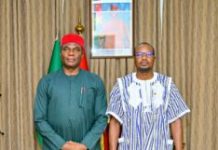
The measures were announced by the Minister of Finance and Coordinating Minister of the Economy, Mr Taiwo Oyedele, on Thursday.
He further disclosed that the Federal Government was negotiating a ceiling of N1,350 per litre on petrol’s ex-gantry or landing cost to promote price stability.
Presidential Spokesperson, Mr. Bayo Onanuga, stated this in a statement on Thursday in Abuja.
Oyedele expressed hope that other fuel marketers would emulate NNPC, noting that the sharp increase in crude oil and petrol prices was not expected to last long.
He, however, cautioned against interpreting the NNPC’s decision as a return to petrol subsidy, which ended on May 29, 2023.
The minister also announced plans for forward sales of crude oil to domestic refineries to help shield petrol prices from global market volatility.
He said the arrangement would be supported by rising crude oil production and the release of previously committed crude volumes.
He explained that under the proposal, refiners and importers would bear costs exceeding the landing cost ceiling and recover the shortfall later when crude oil prices or the exchange rate improved.
“This is neither a subsidy nor a price control: it is designed to smooth prices over time rather than suppressing them,” Oyedele said.
He explained that maintaining relatively stable prices would provide greater certainty for households and businesses than frequent sharp increases and decreases.
Oyedele said the ceiling would be reviewed monthly, adjusted according to prevailing costs and published to ensure transparency.
He also said the Federal Government, in collaboration with state governments and security agencies, was working to curb road taxes and levies that increase transport fares and logistics costs.
The initiative would be implemented under the 2025 tax reform laws to reduce the burden of multiple charges on businesses and commuters.
The Federal Government is also increasing funding for cash transfers to vulnerable households and providing subsidised credit for small businesses and consumers.
Other measures by the government include
accelerating the rollout of compressed natural gas (CNG) in collaboration with state governments to reduce transportation costs.
According to Oyedele, CNG is 60 to 70 per cent cheaper than petrol, with transport operators expected to reflect the savings in lower fares.
The government is also considering an excess profit tax on operators who exploit consumers across the energy value chain.
Proceeds from taxes on excessive profiteering would be used exclusively to cushion fuel price increases through transport support or vouchers for urban minimum-wage earners.
The Federal Government would also work with the National Assembly to consider enhanced tax relief for low-income earners under the 2027 Finance Bill.
Other measures include reducing regulatory costs that contribute to higher prices of goods and services and investing in a National Strategic Fuel Reserve to protect households and businesses against future energy supply disruptions.
Under the proposed arrangement, refined petroleum products would be released into the market under published rules whenever global disruptions or hoarding threatened supply and price stability.
The government said the reserve would help prevent artificial scarcity, discourage market manipulation and strengthen long-term energy security without restoring subsidies or fixing prices.
The newly launched address codes by the Nigerian Postal Service (NIPOST) are also expected to improve logistics efficiency and reduce delivery costs.
The Presidency acknowledged the hardship Nigerians face following increases in petrol prices but maintained that restoring blanket subsidies would create longer-term economic challenges.
“Removing the fuel subsidy came at a price. But the alternative has been tried.
“Nigeria has already lived through that cycle: scarcity, smuggling, a collapsing currency and a fiscal crisis,” the presidency said.
The Presidency said the government remained committed to ensuring that the benefits of economic reforms reached more Nigerians through targeted support.
It added that the Federal Government was working on a comprehensive package of fiscal measures to sustainably reduce inflation to single digits in the near term. (NAN)