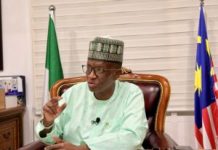
The Minister of Budget and Economic Planning, Sen. Atiku Bagudu, has urged the media to deepen engagement with Nigeria’s budget process.
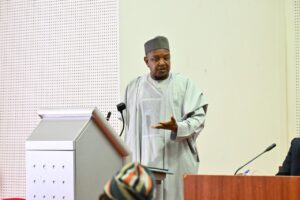
Bagudu made the call at the Senate Press Corps Capacity-Building Workshop in Abuja on Monday.
The News Agency of Nigeria (NAN) reports that the workshop’s theme is: ‘Leveraging Legislative Oversight and Media Collaboration to Safeguard the National Budget from Unlawful Insertion.’
The minister said informed public discourse on Federal Government reforms would strengthen accountability and help citizens understand development priorities.
He said effective scrutiny of the national budget must go beyond identifying controversial provisions to understanding their constitutional basis and rationale.
Bagudu urged journalists to ask pertinent questions and thoroughly investigate budget provisions rather than draw conclusions without sufficient context.
According to him, Nigeria’s budget conversation must begin with a fundamental question: “What is the national budget, and what should it be?”
He said Nigeria’s limited fiscal space, given its population and development needs, made resource mobilisation an important national conversation.
He also stressed the need to examine the scale of public investment required to achieve the country’s development aspirations.
Bagudu linked the workshop to President Bola Tinubu’s Renewed Hope Agenda and the administration’s ambition to build a prosperous and inclusive economy.
He noted that Nigeria’s long-term development framework under Agenda 2050 provided broader context for government decisions.
The minister said the ambition to build a $1 trillion economy required Nigerians to confront difficult questions about resource mobilisation.
“Should we continue with a budget that leaves our populace with one of the smallest budgets, or should we consider how we can mobilise more resources?” he asked.
Bagudu said decisions on revenue, expenditure and borrowing could not be separated from public confidence in government.
He stressed that citizens’ understanding and support were important to the government and National Assembly when making major fiscal decisions.
The minister also underscored the National Assembly’s constitutional role in the budget process, noting its authority over the national budget.
He called for greater public understanding of the relationship between the Executive and legislature in shaping the budget.
Bagudu encouraged the media to strengthen scrutiny through evidence-based reporting, particularly when examining alleged budget insertions.
He cautioned against assuming that every unfamiliar budget provision constituted an irregularity, urging journalists to investigate its origin and purpose.
He said the beneficiaries of specific provisions should also be examined before conclusions were reached about their legitimacy.
Bagudu cited water infrastructure in underserved communities and equipment for fishing communities as examples of potentially misunderstood provisions.
He, however, said such context should not diminish the need for vigilance by journalists and legislative oversight institutions.
“We are dealing with human processes and human errors. Therefore, vigilance is necessary, and the media and legislative oversight should remain vigilant,” he said.
The minister called for balanced discussions on budget transparency, particularly where disclosure of sensitive information could affect national security.
While affirming transparency, accountability and the public’s right to know, he urged responsible reporting that considered the wider national interest.
Bagudu also challenged assumptions that capital expenditure was inherently more valuable than recurrent expenditure.
According to him, spending on security, education, healthcare, human capital and public-sector personnel can have direct developmental consequences.
He said budget expenditure should therefore be assessed based on the outcomes it delivers rather than whether it is classified as capital or recurrent.
The minister underscored the importance of meeting debt-service obligations, warning that failure could affect borrowing costs.
He said higher borrowing costs could ultimately have consequences for private-sector operators and the wider economy.
Bagudu urged the media to rigorously hold public institutions accountable while keeping Nigeria’s broader development challenges in perspective.
“How careful are we to ensure that, while insisting on holding public officials to account, we do not lose sight of the bigger picture?” he asked.
He said the media had an important role in helping Nigerians understand choices facing the country.
Bagudu said government was seeking to address historic under-investment in education, security, roads and water infrastructure.
He said transforming the economy would require government action, public support and public imagination.
The minister therefore urged the media to help bring discussions on Nigeria’s development choices to the forefront. (NAN)