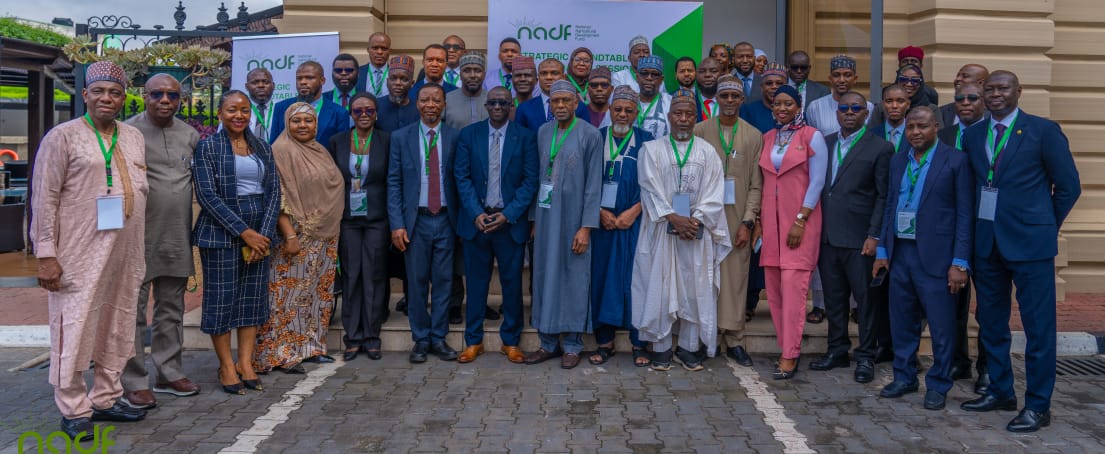
The National Agricultural Development Fund (NADF) has commenced validation of its proposed Non-Interest Finance Framework and Guidelines to widen access to agricultural finance and support the Federal Government’s food security objectives.
Mr Mohammed Ibrahim, Executive Secretary of NADF, said this on Tuesday in Abuja at a Strategic Roundtable and Validation Session on the proposed framework and guidelines.
Ibrahim said the initiative was part of NADF’s efforts to ensure that farmers, agribusinesses and other actors across the agricultural value chain had access to diverse and innovative financing options.
He said non-interest finance had become an important component of Nigeria’s financial system, offering ethical, asset-backed and risk-sharing models that complemented conventional financing.
“Our objective is not simply to introduce another financing framework. It is to broaden the financing ecosystem for agriculture by ensuring that every credible financing option is available to Nigerian farmers, agribusinesses and other value-chain actors.
“The proposed framework will provide a structured and transparent basis for delivering agricultural interventions through licensed Non-Interest Financial Institutions while institutionalising governance, operational and Shari’ah compliance standards.
“These documents are deliberately presented as drafts to allow stakeholders to scrutinise them and contribute their expertise before finalisation.
“Today’s gathering marks an important milestone in that journey. I urge participants to examine the draft documents critically, challenge assumptions where necessary and share practical experiences,” he said.
Earlier, Mr Olalekan Alabi, NADF Head of Investment, said the proposed framework and guidelines were designed to establish a structured mechanism for deploying non-interest financing to eligible agricultural activities and value-chain interventions.
Alabi said the framework would provide the institutional and operational architecture for NADF’s non-interest finance activities, including governance arrangements, institutional responsibilities, financing approaches, risk management, compliance and controls.
He said the accompanying guidelines would translate those principles into practical procedures for implementing specific financing interventions.
“Together, the Framework and Guidelines are expected to provide clarity on how NADF’s non-interest financing interventions will be structured, assessed, approved, implemented, monitored and reported.
“The validation session is an opportunity to test whether the proposed framework can work effectively in practice. We are here to test their technical robustness and practical applicability,” Alabi said.
He identified key areas for scrutiny as the framework’s institutional architecture, financing structures, stakeholder responsibilities, risk management and control mechanisms, Shari’ah and regulatory considerations, as well as the practicality of implementation.
He said stakeholders were expected to identify gaps, inconsistencies, overlaps and provisions requiring further clarification before the documents were finalised.
According to him, the objective was to produce a framework and guidelines that were clear, technically sound, operationally practical and appropriately governed to support NADF’s non-interest agricultural financing interventions.
Dr Paul Oluikpe, Director, Development Finance Advisory Department of the Central Bank of Nigeria (CBN), said significant work remained to improve access to agricultural finance in the country.
Oluikpe recalled that the CBN was involved in the early development of NADF and provided conceptual support in shaping its direction.
He welcomed the proposed framework, saying it provided an opportunity to bring an often-overlooked dimension of agricultural financing into the mainstream.
“The scale of Nigeria’s agricultural financing needs remains enormous, considering the country’s population, the importance of agriculture to the economy and the challenges across the sector.
“The challenges extend from agricultural production to infrastructure, mechanisation and other critical areas of the value chain.
“The Federal Government’s food security objective has made institutions such as NADF particularly important in mobilising resources and closing gaps in agricultural finance.
“CBN’s Development Finance Advisory Department has moved away from direct developmental interventions, making institutions such as NADF important in filling the gap,” he said.
Oluikpe urged NADF to draw on the expertise of non-interest finance specialists and other stakeholders to ensure that the framework was appropriate for Nigeria’s financial system.
Prof. Bashir Umar, Deputy Chairman of CBN’s Financial Regulation Advisory Council of Experts (FRACE), said the proposed framework was consistent with efforts to promote financial inclusion and expand access to finance.
Umar said the integration of non-interest financing into Nigeria’s formal financial system was part of broader financial-sector development efforts, noting that several development finance institutions had introduced or were considering non-interest finance windows.
He said NADF’s initiative could help more Nigerians participate in the formal financing system, especially in agriculture.
“What we are witnessing at the moment is also following this trajectory of financial inclusion and easy access to finance and having a level playing field and even developmental perspective for the whole country whereby no segment of society is left out.
“Non-interest financing can complement existing financing mechanisms and contribute to efforts to mobilise resources for agriculture, which employs a significant proportion of Nigerians,” Umar said.
He said the participation of regulators, development finance institutions, financial-sector operators and academics in the validation process would help strengthen the proposed framework.
“Financial institutions will provide practical insight into how the proposed interventions can be channelled through the banking and financial system, while academics and technical experts can contribute to the policy and technical dimensions,” he said.