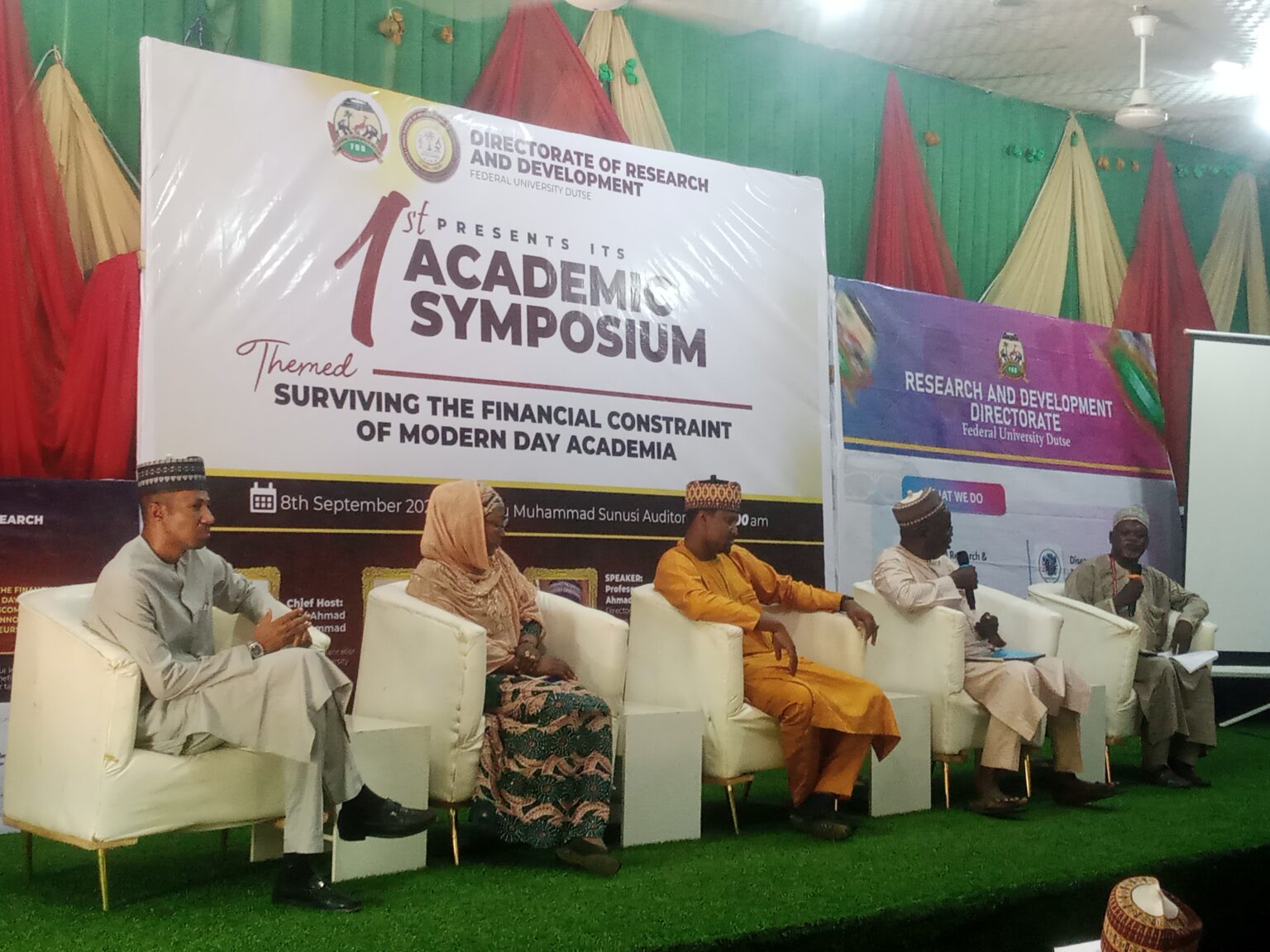
The Vice-Chancellor, Federal University Dutse (FUD), Prof. Ahmad Muhammad-Gumel, has urged academics to commercialise their research and expertise to create additional sources of income.
Muhammad-Gumel made the call on Tuesday at the university’s first Academic Symposium, organised by the Directorate of Research and Development in Dutse.
The symposium has the theme: “Surviving the Financial Constraint of Modern Day Academia: Building a Parallel Income Engine through Research, Innovation and Entrepreneurship.”
It focused on ways academics could generate income from their knowledge without compromising their academic responsibilities.
He said that the financial pressures facing Nigerian universities required academics to look beyond the traditional “publish or perish” approach.
“We will move away from traditional, outdated mindset of publish or perish. We will analyse how to build a parallel income engine without compromising your academic integrity or your passion for research,” the vice-chancellor said.
He said that seeking additional income should not mean abandoning the university system, but finding opportunities within it.
“The goal is not to abandon the ivory tower but to find your place within the ivory tower,” Muhammad-Gumel said.
He said that greater financial independence could also provide academics with more freedom to pursue their research interests.
“Financial autonomy brings academic freedom,” the VC said.
Earlier in his welcome remarks, Prof. Salihu Ibrahim, the Director, Directorate of Research and Development, FUD, said that the financial pressure on universities had exposed a gap between the intellectual value generated by academics and the financial returns from their expertise.
Ibrahim described the situation as an “academic paradox”, saying that academics were adept at converting financial resources into knowledge through research but often struggled to convert that knowledge into financial resources.
He said that the symposium was aimed at providing academics with practical tools and entrepreneurial frameworks to bridge the gap between academic expertise and market opportunities.
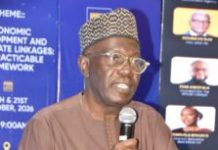
In his keynote presentation, Prof. Nasir Faruk, Deputy Vice-Chancellor, Academic, Sule Lamido University, Kafin-Hausa, said that academics needed to move from active labour to productive value.
Faruk, an Information Technology and Telecommunications specialist, identified consultancy, external engagements, research commercialisation, investment through financial markets and cooperative societies, adjunct teaching, tutoring and digital content creation as avenues through which academics could generate additional income.
He said that academic knowledge could also be developed into products and services through research findings, professional skills, technologies and solutions to institutional and community problems.
Another keynote speaker, Prof. Ibrahim Ahmad-Rufai, a former Director, DRIP, Bayero University, Kano, said that building a functional research, innovation and entrepreneurship ecosystem required support across several areas.
Ahmad-Rufai, a Mechanical Engineering scholar, identified human capital, policy, institutional culture, support, finance, community and markets, research and education as key components of the ecosystem.
The symposium also featured a panel discussion, as panelists facilitated the interactive session, where participants examined practical ways of applying academic expertise and research to income-generating opportunities. (NAN)(NAN)