Nigeria has unveiled a five-year National Strategy for Combating Organised Crime aimed at dismantling criminal networks, disrupting illicit financial flows and strengthening inter-agency response.
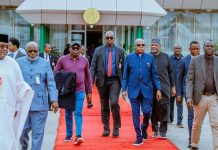
The National Security Adviser (NSA), Malam Nuhu Ribadu, represented by the National Coordinator, National Counter-Terrorism Centre (NCTC), Maj.-Gen. Adamu Laka, unveiled the strategy on Monday in Abuja.
Ribadu said the strategy, covering 2027 to 2031, would provide an integrated framework for confronting terrorism, drug trafficking, human trafficking, cybercrime, maritime crime, corruption and illicit financial flows.
He said the sophistication of criminal networks demanded more than institutional strength, requiring “coherence, coordination and intelligence-driven collaboration across all relevant sectors.”
“Organised crime now operates in interconnected webs that undermine development, economic growth and public safety,” he said.
Ribadu said the strategy adopted a whole-of-government and whole-of-society approach, with stronger inter-agency cooperation and enhanced collaboration with international partners.
He urged ministries, departments and agencies involved in the implementation to sustain the cooperation that produced the strategy.
“With the launch of this strategy, we are reinforcing our resolve with a clear national framework that will enable us to anticipate threats, disrupt criminal networks, strengthen institutional coordination and ensure that those who profit from organised crime are brought to justice.
“The success of this strategy will depend on how faithfully, diligently and collaboratively it is implemented,” Ribadu said.
The NSA said the Office of the National Security Adviser would support implementation through intelligence fusion, operational synergy and strengthened coordination.
He also commended the Technical Working Group for its consultations, drafting, review and validation of the strategy.
UNODC Country Representative in Nigeria, Mr Cheikh Touré, said organised crime had evolved into a sophisticated ecosystem capable of exploiting institutional gaps and operating across national boundaries.
Touré said the strategy must translate into practical action, warning that national strategies often failed not in their drafting but in implementation.
“If there is one lesson that repeats itself in nearly every case, it is this: strategies rarely fail in the writing. They fail in coordination or resources,” he said.
He described organised crime as “not a peripheral security issue,” but a tax on development, investment and public confidence in institutions.
Touré urged Nigeria to increase domestic investment in law enforcement and justice institutions, saying international assistance should complement rather than substitute national commitment.
“The real test of this strategy will not be written in Abuja. It will be felt across communities in every part of this country by 2031,” he said.
U.S. Director, Bureau of International Narcotics and Law Enforcement Affairs, Mr Tolliver Derrick, said the strategy represented a milestone in the law enforcement partnership between Nigeria and the United States.
Derrick said organised crime and terrorist financing were increasingly interconnected threats requiring countries to work together.
He said the U.S. would support Nigeria in building capacity to disrupt criminal networks, trace illicit financial flows and strengthen cooperation with international law enforcement organisations.
“Preventing illicit financial transfers and related cybercrime are not solely American problems. They are shared problems that demand shared solutions.
“Every criminal network disrupted here reduces the threat to American communities and to Nigeria,” Derrick said.
Mr Sa’ad Abubakar, National Coordinator, National Cyber security Coordination Centre (NCCC-ONSA), identified implementation and information sharing as critical to the success of the strategy.
He commended the strategy for assigning implementation responsibilities to specific agencies, saying such clarity would help address one of the major weaknesses of previous national strategies.
Abubakar said NCCC-ONSA remained committed to implementing the strategy, particularly in strengthening the response to cybercrime.
He said the launch marked the beginning of a more coordinated national effort to dismantle criminal networks and protect Nigerians from the growing threat of organised crime. (NAN)