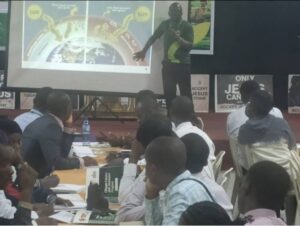
Mr Lolu Akindele, Chief Sustainability Officer, Global Impact Sustainable Development Enterprise (GISDEVE), says 125 participants are undergoing climate literacy training at the Redeemed Christian Theological College (RCTC).
Akindele disclosed this on Thursday at the Climate Literacy and Awareness Programme(CLAP) organised for students of the RCTC, Redemption City, Lagos-Ibadan expressway.
He said CLAP was designed in collaboration with the University of the West of England, Bristol, and accredited by the Carbon Literacy Project (CLP), United Kingdom.
Akindele said the program was aimed at promoting climate education across Africa, adding that similar training had been conducted in Oyo State and in Ghana.
He said more than 300 teachers were trained in Oyo State in July, while the RCTC programme targeted about 125 participants.
The chief sustainability officer stated that religious groups were engaged because climate change affects everyone, and faith leaders can amplify the message across their congregations.
He added that teachers were also targeted because of the number of students they influenced, while trained pastors could similarly transfer climate knowledge to their congregations.
Akindele said participants would develop individual action plans after learning about climate change, greenhouse gases, global warming and their environmental effects.
“Everyone has a role to play. Participants will identify what they can do individually to reduce greenhouse gas emissions and contribute to global change.
“Participants will also develop group action plans and receive internationally recognised certificates after meeting the programme’s requirements,” he said.
Akindele urged churches to take the lead in promoting climate action, stressing that religious institutions could not afford to remain outside the campaign.
Earlier, the Provost of RCTC, Pastor Rotimi Oti, urged Christians to embrace responsible environmental stewardship to promote sustainability and combat climate change.
Oti said climate change was no longer a distant environmental concern, as it was already affecting communities, economies, health, agriculture, livelihoods and future generations.
He said Christian stewardship extended beyond theological education and church activities to include responsible care for God’s creation and protection of the environment.
Oti said climate literacy encompasses ethical, theological, social, economic and spiritual dimensions, emphasising that knowledge must lead to practical action.
He highlighted theological institutions’ unique role in raising up pastors, teachers, and leaders who treat environmental responsibility as an essential part of spiritual and academic excellence.
One of the participants, Stella Nwachi, said the training had deepened her understanding of the effects of climate change on Nigerians.
Nwachi said her major takeaway from the training was the need to develop practical solutions to mitigate the effects of climate change on humanity. (NAN)