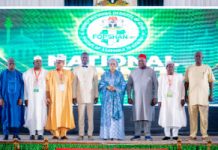
The Nigerian Ports Consultative Council (NPCC) has called for seamless port operations and simplified cross-border trade processes to enhance Nigeria’s competitiveness and economic growth.
The Vice Chairman of NPCC, Chief Jean Anishere, made the call on Thursday in Lagos at the council’s quarterly meeting with the theme “Simplifying Cross-Border Trade and Enhancing Ease of Doing Business at Our Ports”.
Anishere, a lawyer, described the theme as timely, saying ports were not merely cargo gateways but critical instruments of national economic development.
She said port efficiency had direct implications for the prices of goods, business competitiveness, investment and the success of international trade.
According to her, efficient cross-border trade requires effective coordination among government agencies, port operators, shipping lines, terminal operators, freight forwarders, customs brokers, financial institutions and traders.
She said fragmented, duplicated and prolonged processes increased costs for businesses and consumers, stressing the need for ports to be seamless, transparent, predictable and business-friendly.
Anishere urged stakeholders to consider how cargo could be moved with fewer physical interfaces, documents and delays, as well as greater certainty on cost and delivery time.
She called for deeper digitalisation and automation through an integrated Port Community System, inter-agency data sharing, electronic documentation and risk-based inspection.
According to her, these measures will reduce duplication, improve transparency and strengthen compliance.
The NPCC vice chairman also emphasised the need for better inter-agency coordination, predictable charges, service excellence, a sound legal framework and greater private-sector participation.
She said geographical location alone could not make a port a hub, adding that efficiency, predictable costs and reliable service were essential.
Anishere said the council, which is 60 years old, had organised three training programmes in Lagos, Port Harcourt and Abuja.
She added that the council was now registered with the Corporate Affairs Commission as a legal entity and had plans to strengthen its branches.
She thanked participating agencies and stakeholders for their contributions, saying the council would continue to improve its engagements to support the growth of the maritime industry.
In his welcome address, the NPCC Chairman, Mr Bolaji Sunmola, thanked stakeholders who travelled from different parts of the country to attend the meeting.
Sunmola said the council provided a platform for stakeholders to discuss challenges, develop practical solutions and assign responsibilities for implementation.
He urged participants to engage in frank and open discussions and ensure that deliberations translated into actionable recommendations for transparent, efficient and business-friendly port operations.
The Director-General of the Nigerian Maritime Administration and Safety Agency (NIMASA), Dr Dayo Mobereola, represented by the Director of Shipping Development, Mr Abdullahi Salihu, said efficient and predictable port operations were central to the growth of the maritime economy and Nigeria’s competitiveness under the African Continental Free Trade Area (AfCFTA).
Mobereola said cross-border trade was a continuous process in which every delay increased costs, eroded confidence and weakened the ability of Nigerian businesses to compete within the AfCFTA market.
He noted that Nigeria’s market size and geographical position did not automatically guarantee increased cargo throughput, stressing the need for reliable trade corridors and transparent, efficient and time-bound compliance processes.
He said the National Single Window, launched on March 27, 2026, was designed to unify import and export documentation, reduce duplication and cut cargo clearance time from 21 days to seven days.
Mobereola also said NIMASA’s e-management system was operational to improve visibility and regulatory decision-making.
He added that the Deep Blue Project, in collaboration with the Nigerian Navy, had contributed to improved maritime security, while Nigeria had regained Category C status at the International Maritime Organisation (IMO).
In her goodwill message, the Managing Director of the Nigerian Export Promotion Council (NEPC), Mrs Nonye Ayeni, represented by the Deputy Director, Mrs Ronke Olaiye, said port efficiency was critical to diversifying Nigeria’s non-oil exports and empowering entrepreneurs.
Ayeni said the AfCFTA provided access to a market of about 1.3 billion people with an estimated value of 3.4 trillion dollars.
She, however, said countries would benefit fully from the market only when their borders and trade corridors enabled goods to move quickly, predictably and affordably.
She called for the adoption of a functional single window, harmonised inspection protocols, real-time data sharing and structured stakeholder engagement.
Ayeni pledged NEPC’s continued partnership with stakeholders to strengthen the voice of exporters and promote a competitive and reliable port system.