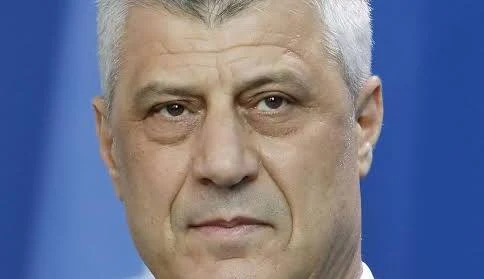
The former president of Kosovo, Hashim Thaçi, was on Wednesday sentenced to 25 years in jail for war crimes by a special court in The Hague, after the court ruled that he was responsible for 96 murders.
Thaçi was charged with other serious crimes, such as torture and cruel treatment. Three co-defendants were also handed lengthy sentences.
The verdicts are not final and can be appealed.
According to a statement by the court, the Trial Panel found that all four Accused were criminally responsible for the war crimes of arbitrary detention against 385 individuals, cruel treatment against 49 individuals, torture against 303 individuals, and murder against 96 individuals.
Thaçi, 58, had previously described himself as “completely innocent” and received the verdict without showing any emotion as presiding judge Charles Smith read out the verdict.
The prosecution had sought a 45-year prison sentence for him for the crimes committed in the late 1990s.
Nearly 300 witnesses testified in the trial and 155 victims participated in the three-year proceedings.
According to the prosecution, Thaçi and three co-defendants were part of the leadership of the Kosovo Liberation Army (KLA), which is alleged to have committed crimes against humanity.
The judge emphasised that the proceedings were not concerned with the KLA’s goals or methods, but solely with “the individual criminal responsibility of the defendants” for war crimes.
Co-defendants Kadri Veseli, Rexhep Selimi and Jakup Krasniqi were sentenced to 18, 13 and 25 years respectively.
The judge said other charges, including cases involving crimes against humanity, were not taken into account in the verdict because of insufficient evidence.
Thaçi served between 2008 and 2020 as Kosovo’s prime minister, foreign minister and president.
He resigned from office to face the court in The Hague.
All four defendants held leading positions in the KLA and high political office after the war.
After the war, western politicians for years accepted Thaçi as a negotiating partner in efforts to find a peaceful solution to the conflict between Kosovo and Serbia.
The KLA fought from 1998 to 1999 for the independence of predominantly Albanian Kosovo from Serbia.
Independence was ultimately achieved with NATO’s assistance, after Serbian security forces had committed serious war crimes against Kosovo’s Albanian population.
Those crimes were investigated by the UN-established International Criminal Tribunal for the former Yugoslavia (ICTY).
The Kosovo Specialist Chambers were established separately in 2015 under international pressure.
They form part of Kosovo’s judicial system but are staffed by international judges and prosecutors.
For security reasons, the court was relocated to The Hague.
The verdict sparked outrage in Kosovo. “It is a sad, unjust, and undeserved decision,” Kosovan Foreign Minister Glauk Konjufca told journalists after leaving the courtroom in The Hague, describing it as a “devastating verdict for Kosovo and for our war of liberation.”
Kosovo’s opposition Democratic Party of Kosovo (PDK), which Thaçi founded after the Kosovo War in 1999 and led for 17 years, described the verdict as a “great injustice.”
The allegations and evidence presented during the proceedings had been invented by Serbian propaganda “to criminalise the KLA’s just war”, the party said in a statement published on Facebook.
Thousands of people across Kosovo watched the verdict being read on large public screens. They then returned home, according to a dpa reporter in Priština.
Large protests against the proceedings, involving tens of thousands of participants, had already taken place the previous Saturday.
In The Hague, several hundred Kosovars protested on Wednesday against the trial and the verdicts, according to the Dutch news agency ANP.
Security forces were reportedly pelted with stones. Police used tear gas to disperse violent protesters.(dpa/NAN