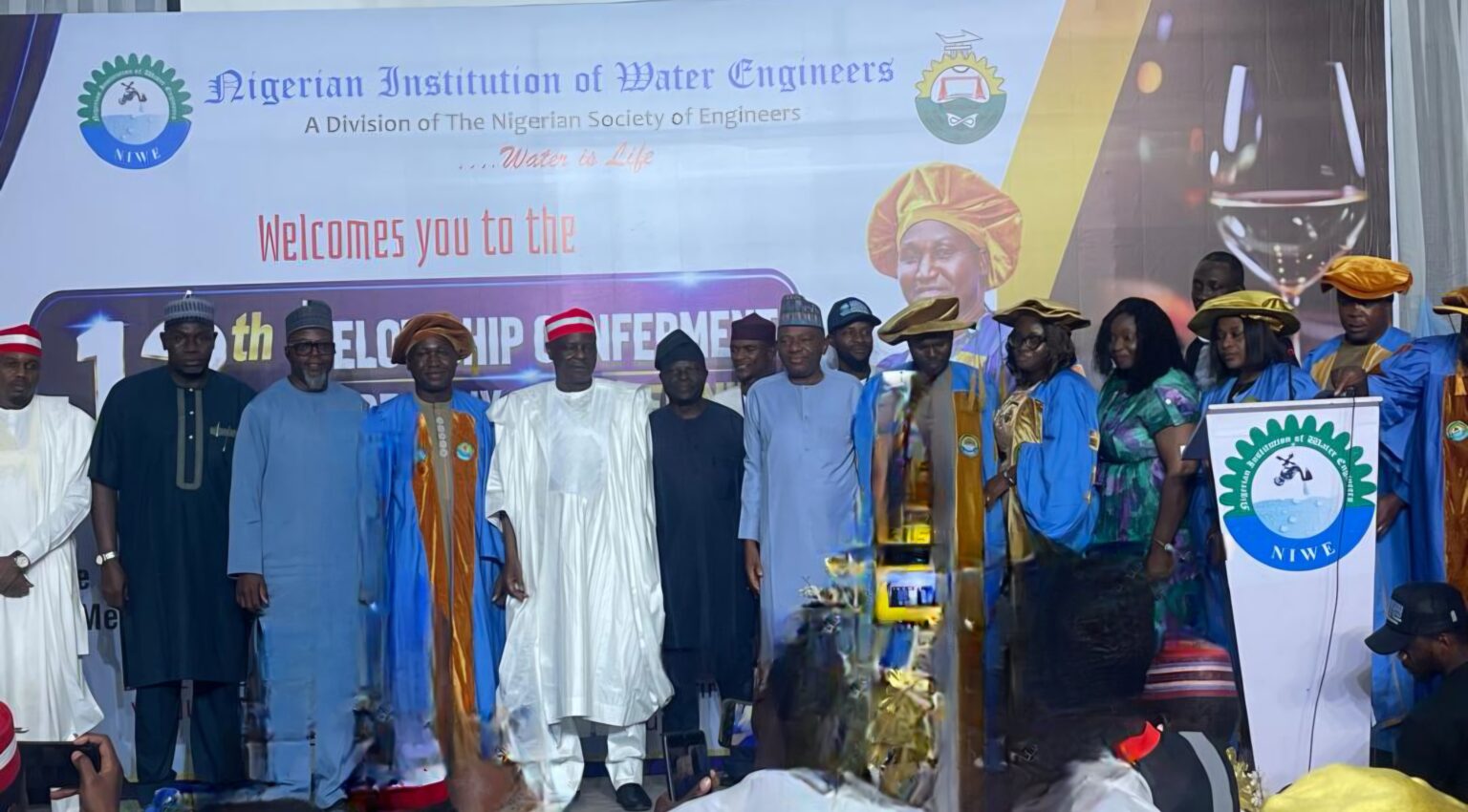
The Nigerian Institution of Water Engineers (NIWE) has charged its newly inducted fellows to use their professional expertise to address Nigeria’s water and sanitation challenges and promote sustainable water supply.
The National Chairman of NIWE, Mr Joshua Sanga, gave the charge at the 13th fellowship conferment ceremony of the institution on Thursday in Abuja, describing Fellowship as its highest professional honour.
Sanga said the conferment was not merely about titles but recognition of excellence, dedication and service to the nation through the water engineering profession.
“You are to advocate for policies that would address Nigerian water and sanitation challenges. You are now an authority in water, so you must be an advocate for sustainable water supply in Nigeria.
“You are to drive innovation in water supply, treatment, irrigation, flood control and climate resilience.
“You are to partner with the government at federal, state and local government levels to achieve the Sustainable Development Goal 6 (SDG 6), which is clean water and sanitation for all. That is the task of the new conferees.
“As we confer this fellowship today, let us remind all of us that engineering is not just about design and pipes; it is about people, it is about communities and it is about our collective future.”
Sanga congratulated the new fellows and charged them to uphold professional ethics, mentor younger water engineers and serve as ambassadors of NIWE.
Also speaking, Sen. Rabiu Kwankwaso, an engineer and Vice Presidential candidate of the Nigeria Democratic Congress (NDC), urged engineers to focus on producing results and creating solutions to societal problems especially in resolving water supply problems.
Kwankwaso described inadequate potable water supply as a major challenge for both professionals and politicians, noting that water was one of humanity’s most fundamental needs.
He said that many cities, particularly in developing countries, still lacked adequate water supply.
“It is unfortunate that today, it is difficult to remember any city, especially in the developing world, that has enough water supply.
“I believe it is a big challenge to all of us as professionals and also a very big challenge for us as politicians,” he said.
The former governor of Kano noted that even Abuja was yet to achieve adequate potable water supply, stressing the need for concerted efforts to address the problem.
Using his experience as an example, Kwankwaso advised young professionals not to remain permanently dependent on salaried employment but have confidence in themselves and be prepared to take calculated risks in their careers.
Meanwhile, the Chairman, Board of Fellows of NIWE, Mrs Chinyere Igwebe, said the fellowship ceremony also featured a lecture entitled, “The Engineer’s Health Lifecycle: Mitigating the Impact of Menopause and Andropause on Professional Output.”
Igwebe said the lecture was designed to draw attention to the importance of health and wellbeing among engineers, particularly as professionals advanced in age.
She noted that many professionals spent most of their productive years pursuing financial security and caring for their families while neglecting their own health.
“We are aging every day and we take our lives for granted. We are hustling for money, looking for money left and right.
“But then we do not take time to take care of our health. And that health that we own, we have, is all that we own,” she said.
Igwebe warned that professionals could fail to enjoy the fruits of their labour if they neglected their health, urging engineers to pay greater attention to their physical and mental wellbeing.
The guest speaker, Dr Getrude Odezugo, explained that menopause and andropause were natural stages of aging that involve significant hormonal changes in both women and men thereby calling for a deliberate change of lifestyle.
Odezugo said her presentation was aimed at reorienting engineers on the need to preserve their health and lives while working to preserve the country’s water resources.
She described the human body as a system that required regular maintenance to function effectively and encouraged engineers to treat their health with the same seriousness they attach to the maintenance of complex engineering systems.
According to her, maintaining the wellbeing of engineers should not be regarded solely as an individual responsibility, as organisations also have a role to play in creating healthier workplaces.
Odezugo noted that midlife was a particularly important period in an engineer’s career because professionals at that stage had accumulated experience, judgment and leadership abilities that could benefit younger generations.(NAN)(NAN)