Undoubtedly, the steady flow of illegal weapons is keeping Nigeria’s security crisis alive.
From rural communities to active conflict zones, an underground trafficking network feeds criminal elements, directly enabling widespread terrorism, kidnapping, and banditry.
While security forces confront armed groups and recover weapons, the Federal Government is increasingly looking beyond the battlefield to disrupt the supply chains sustaining violence.
At the forefront is the National Centre for the Control of Small Arms and Light Weapons (NCCSALW), under the Office of the National Security Adviser (ONSA).
The centre’s strategy is expanding from weapons recovery to understanding where illicit arms originate, how they move, where they are diverted and how circulation can be stopped.
The National Security Adviser, Malam Nuhu Ribadu, has described illicit weapons as “a deadly threat to the safety of our people”.
According to him, their proliferation sustains banditry in the North-West, communal conflicts in the North-Central and terrorist operations in the North-East.
The NSA said government’s response was anchored on stronger inter-agency collaboration, disruption of criminal financing networks, enhanced border security and international partnerships.
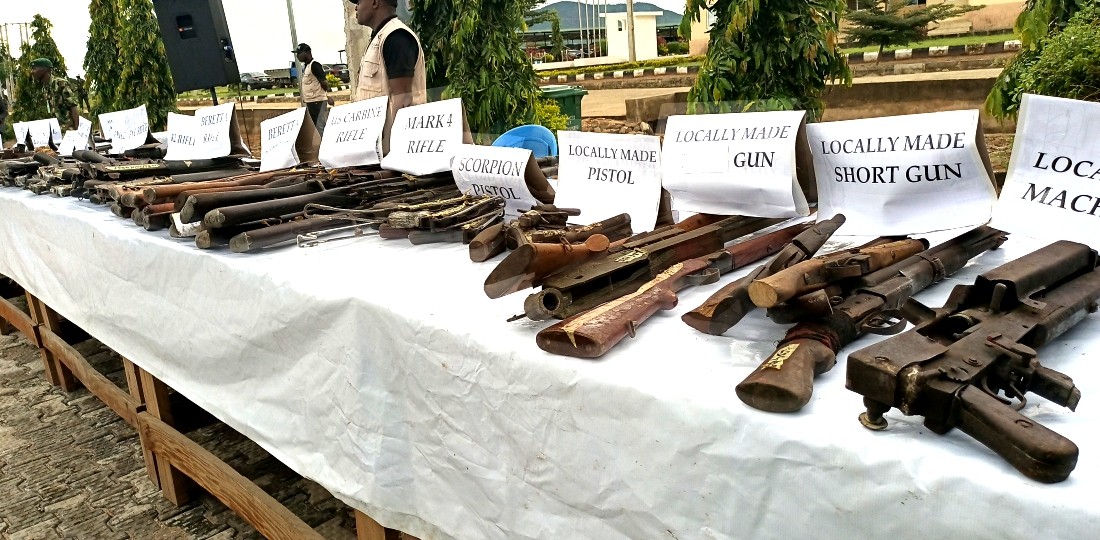
At the recovery end, NCCSALW has continued to remove weapons permanently from circulation through transparent destruction exercises.
In its latest exercise, the centre destroyed 2,819 illicit, decommissioned and unserviceable weapons, bringing the number destroyed by the centre to about 19,000.
Ribadu said the exercise demonstrated government’s commitment to ensuring recovered weapons never return to criminal hands.
“Recovering weapons alone is not enough. Public, transparent and verifiable destruction guarantees that these recovered weapons can never again be used against any Nigerian,” he said.
Yet, destruction addresses weapons already recovered. The bigger challenge is preventing replacement firearms from continuously entering the illicit market.
This has placed greater emphasis on securing legitimate weapons, strengthening armouries and preventing diversion from official stockpiles.
NCCSALW Director-General, retired DIG Johnson Kokumo, identified poor armoury management and diversion of government-owned weapons as major proliferation drivers.
He said porous borders, illicit local production and leakage from official stockpiles were among the major sources of illicit weapons.
“The most concerning source of proliferation remains the leakage of weapons from illicit stockpiles held by government agencies.’’
He warned that weapons procured for national security could become instruments of insecurity when weak controls and accountability gaps allow them to reach criminal networks.
Consequently, NCCSALW has intensified capacity development for personnel responsible for arms and ammunition management across security institutions.
The training focuses on record-keeping, storage standards, physical security, accountability and weapons tracking.
A recent programme organised with the HALO Trust and supported by the Netherlands sought to strengthen physical security and stockpile management.
Kokumo urged participants to apply the knowledge acquired, describing them as agents of change in improving arms management.
“You are returning as agents of change. Nigeria is counting on you to enforce accountability and professionalism in arms management.”
However, stronger armoury controls and weapons destruction cannot fully address the problem without knowing its current scale, sources, routes and patterns.
Nigeria’s last national baseline survey on illicit small arms and light weapons was conducted in 2016 and released in 2021.
A decade later, NCCSALW says the data can no longer adequately capture the country’s changing security environment.
Kokumo said Nigeria was preparing a new national baseline survey to provide updated statistics for planning and policymaking.
“The 2016 survey can no longer address the current pattern of proliferation of small arms and light weapons in Nigeria.”
He said the proposed survey would be Nigerian-owned and conducted primarily by Nigerian experts, with technical assistance from international organisations.
“We want to have an arms survey conducted by Nigeria for Nigerians and owned by Nigerians,” Kokumo said.
According to him, updated statistics will help government develop appropriate policies and improve national security planning.
Dr Adedeji Ebo, Director and Deputy High Representative of the United Nations Office for Disarmament Affairs (UNODA), said the available data was outdated.
“It is not that there is no data. There was a baseline survey conducted on small arms circulation in Nigeria in 2016.”
“That was a decade ago. Imagine Nigeria’s security landscape a decade ago and the security landscape today. A lot has changed.”
Ebo said changes had occurred in arms sources and routes, storage, tracing and marking, as well as activities of non-state armed groups.
“If government is going to have accurate national security planning, they need accurate data.
“So, what we have now is literally out of date, out of context.”
The new survey is expected to examine the nature, scale, distribution, sources and drivers of illicit arms proliferation across Nigeria.
UNODA and the Small Arms Survey in Geneva are expected to provide technical support and train Nigerian experts through a training-of-trainers approach.
Ebo said the process would enable Nigeria to build indigenous expertise capable of conducting future surveys and supporting similar exercises across Africa.
But data gathering alone cannot stop weapons proliferation. The information must translate into policies and interventions capable of closing identified vulnerabilities.
“The survey is not itself the end. It is a means to an end. So we need to have a policy that will flow from that survey.”
Beyond government and international partners, NCCSALW is also widening the response to include civil society organisations and communities.
At a recent roundtable, NCCSALW and UNODA engaged CSOs on strengthening community participation in arms-control efforts.
Ebo described CSOs as uniquely positioned to connect government policies with communities affected by illicit arms proliferation.
“Civil society is the bridge between the state and society,” he said.
He said traditional and religious leaders, women, youths, farmers, fishers and survivors of armed violence should contribute to the survey process.
Representing the National Arms Registrar, retired Maj.-Gen. Bamidele Shafa said CSOs’ proximity to communities provided valuable information on illicit weapons.
He said CSOs would play central roles in designing, validating and disseminating findings from the forthcoming baseline survey.
The EU also identified awareness creation, early warning, conflict prevention, policy advocacy, rehabilitation and reintegration among areas where CSOs could contribute.
The approach reflects a growing recognition that illicit arms proliferation is not merely a security-agency problem, but a national challenge requiring community ownership.
Nigeria’s challenge is further complicated by the transnational character of arms trafficking, making regional and international cooperation indispensable.
UNODA is supporting Nigeria through technical assistance, arms tracing and marking, policy development and implementation of international arms-control instruments.
At home, NCCSALW’s collaboration with the Armed Forces, police, intelligence services, Customs and other agencies remains crucial to disrupting illicit arms networks.
The ultimate objective is to prevent illicit weapons from becoming fuel for violence.
The success of the campaign, therefore, should not be measured only by the number of guns seized or destroyed.
The greater victory will come when Nigeria can identify supply lines, close loopholes and make it increasingly difficult for illegal weapons to reach criminal hands.
That is the battle beyond the battlefield — fought through intelligence, accurate data, secure armouries, effective borders, responsible communities and sustained national coordination.
For NCCSALW and its partners, choking the illicit arms pipeline could prove as important to Nigeria’s security as defeating those who wield the weapons.
Analysts say every trafficking route disrupted, armoury secured, weapon traced and firearm permanently destroyed represents another link broken in the chain of violence. (NANFeatures)