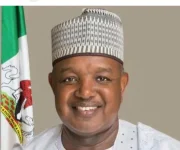
U.S. Consul General Brandon Hudspeth says collaboration between Nigerian innovators and American investors can close funding gaps, expand infrastructure, develop skills and support startups’ global growth.
Hudspeth made this known on Wednesday at the GITEX Nigeria Startup Festival in Lagos.
He highlighted the expanding role of American capital in Nigeria’s technology ecosystem.
“Nigeria’s technology ecosystem is attracting significant international investment, but startups still face funding gaps, infrastructure challenges and limited access to global markets,” he said.
According to Hudspeth, U.S.-based investors remain the largest source of external capital for Nigeria’s technology ecosystem over the past decade.
He explained that the investment had supported startups, digital infrastructure, technology skills and access to international markets.
“U.S.-sourced funding accounts for an estimated 60 per cent of all venture capital entering Nigeria,” he noted.
Hudspeth linked the scale of U.S. investment to Lagos’ rapid emergence as one of Africa’s most prominent technology ecosystems.
He added that Lagos technology ecosystem valuation had increased nearly 12-fold since 2017, while the city had produced six of Africa’s 10 unicorns.
According to him, Lagos ranked first on Dealroom’s 2025 Global Tech Ecosystem Index ‘Rising Stars’ list, ahead of Istanbul, Mumbai and São Paulo.
He noted that the ranking demonstrated the depth of Lagos technology ecosystem and its growing appeal to international investors and technology companies.
Hudspeth disclosed that Lagos currently had more than 3,300 startups, while Nigeria’s technology industry contributed more than 16 per cent to the country’s gross domestic product.
He pointed out that U.S. involvement in Nigeria’s technology sector extended beyond traditional venture capital to major technology and financial companies.
“Visa, Google, Mastercard, Microsoft, Uber and PayPal were among the American companies participating in Nigeria’s technology ecosystem, ” he said.
He added that smaller U.S. venture capital firms and philanthropic organisations were also supporting technology development in Nigeria.
According to him, the Gates Foundation and Chan Zuckerberg Initiative are expected to increase their involvement in Nigeria’s technology and innovation ecosystem.
Hudspeth explained that American companies were providing Nigerian startups with training, infrastructure, connectivity and technology platforms to help them develop products and reach international customers.
He noted that Google and Meta had invested in subsea cable infrastructure serving Nigeria, while Equinix and Digital Realty were connecting Nigerian data infrastructure to global networks.
The consul general further identified Amazon Web Services, Starlink and other U.S.-linked technology companies as contributors to the digital infrastructure supporting Nigeria’s growing technology sector.
He stressed that stronger infrastructure would be critical as Nigerian startups expanded into artificial intelligence, fintech, healthtech and enterprise technology.
Hudspeth also highlighted the role of the technology relationship in strengthening Nigeria’s human capital through training programmes provided by major American technology companies.
“Google, Cisco, Meta and Microsoft are training hundreds of thousands of Nigerians in technology and artificial intelligence, ” he said.
According to him, the programmes are helping to address the shortage of skilled professionals needed to sustain the growth of Nigeria’s digital economy.
Hudspeth described the relationship as mutually beneficial, giving American companies access to Nigeria’s large pool of young technology talent and innovative businesses.
He added that the combination of Nigerian talent, American capital and global technology infrastructure could create economic opportunities for companies and workers in both countries.
The consul general, however, cautioned that Nigerian startups were operating in a more challenging global funding environment, with investors becoming increasingly selective.
He explained that founders now needed stronger revenues, clearer paths to profitability and more sustainable business models to secure international investment.
Hudspeth maintained that continued U.S. participation could help Nigerian startups navigate the funding environment and build companies capable of competing in global markets.
He expressed optimism that the next generation of Nigerian unicorns could emerge from entrepreneurs participating in the GITEX Nigeria Startup Festival.
“Just maybe the next six unicorns will be developed by the talent that is in this room today,” he added.
Hudspeth noted that the U.S.-Nigeria Commercial and Investment Partnership was also supporting efforts to address regulatory and commercial barriers affecting businesses.
He explained that the U.S. Consulate was bringing entrepreneurs, investors, business leaders and policymakers together to improve trade and investment between both countries.
According to him, the initiative is designed to increase business predictability, unlock investment opportunities and create conditions for companies to expand across both markets.
“Lagos is the best place in Africa to demonstrate the U.S. partnership in tech,” Hudspeth concluded.
The News Agency of Nigeria (NAN) reports that GITEX Nigeria Startup Festival brought together startups, investors, technology companies, government representatives and other stakeholders in the country’s digital economy.(NAN)