The National Population Commission (NPC) says it has extended digital civil registration services to about 4,000 of Nigeria’s 8,809 wards, with plans to establish 8,000 registration centres nationwide.
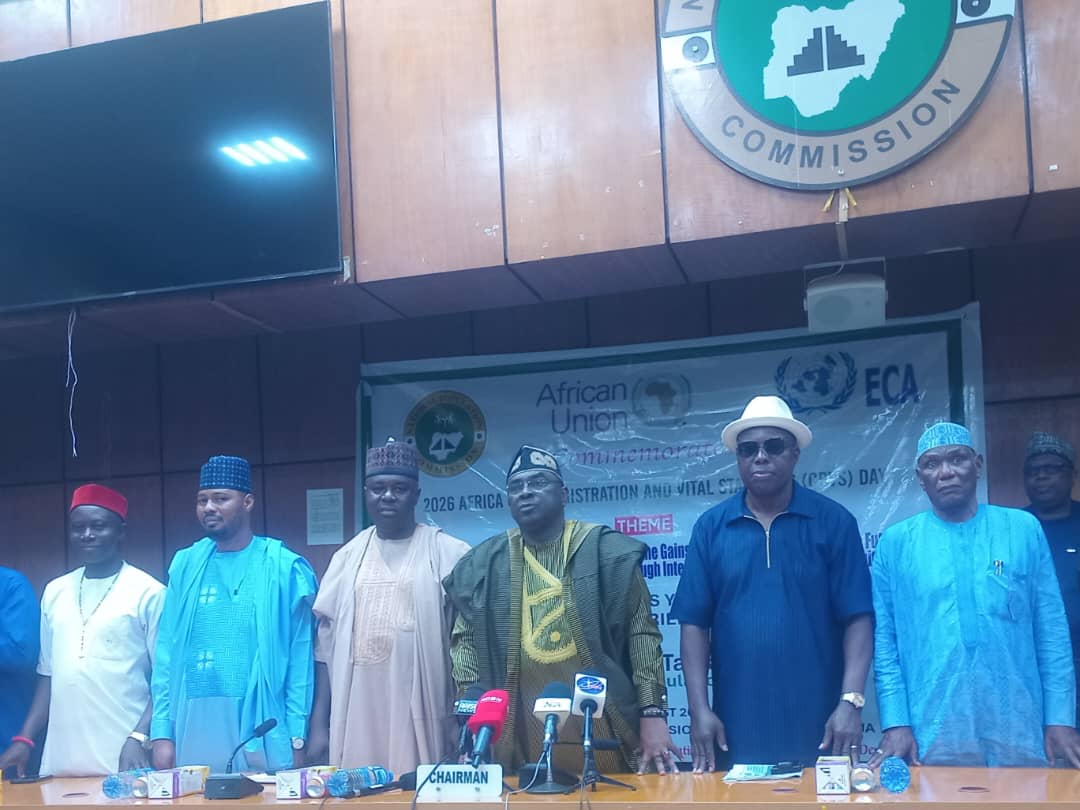
The Chairman of the Commission, Dr Aminu Yusuf, disclosed this on Monday in Abuja at a media conference to commemorate the 2026 Africa Civil Registration and Vital Statistics (CRVS) Day.
The theme is “New CRVS Decade (2026–2036): Consolidating the Gains of Africa Programme on Accelerated Improvement (APAI-CRVS) and Securing the Future of Civil Registration and Vital Statistics in Africa through Integration, Decentralisation and Digitalisation”.
Yusuf said the expansion was aimed at decentralising civil registration and making birth and death registration more accessible, especially at the community level.
He said the commission had established more than 4,000 functional registration centres across the 774 Local Government Areas.
“Combined with the nationwide deployment of the VitalReg platform, this expansion will bring registration services much closer to communities,” Yusuf said.
He said Nigeria inaugurated its nationwide fully digital CRVS system on the VitalReg platform on July 1, ending the manual registration system.
“Digitalisation enables the timely production and dissemination of vital statistics,” he said.
Yusuf said more than five million children were born annually in Nigeria, while significant gaps remained in the registration of births and deaths.
He said the commission was collaborating with the Association of Local Governments of Nigeria (ALGON), National Identity Management Commission (NIMC), UNICEF and Bankforte Technologies Ltd. to address the gaps.
He added that the commission was working with the National Primary Health Care Development Agency, state governments and health institutions to integrate birth registration into routine health services.
Mrs Adaku Obodo, Head, Birth and Death Registration at NPC, said integration with NIMC was helping to prevent duplication of identities.
She said once a child was registered, a unique number was generated and linked with the mother’s identity before a National Identification Number (NIN) was issued.
Obodo said the system would detect existing records and prevent multiple registration of a child.
She said birth registration had also been integrated into routine immunisation services in government hospitals, with trained nurses assisting with the process.
At the community level, she said ward registrars were working with traditional rulers, opinion leaders and other local structures to identify and document vital events.
Obodo said the commission had trained about 4,000 ALGON registrars to conduct birth registration, with efforts continuing to cover remaining areas.
She said the commission was developing a community birth alert system with support from UNICEF to enable community structures to notify registrars whenever a birth occurred outside a health facility.
“This is to ensure that as we progress with digital registration, all aspects are covered, both at the health facility and community level,” she said.
The Chief of Child Protection, UNICEF Nigeria, Ms Natalie McCauley, described birth registration as a fundamental right and a child’s first legal recognition by the state.
“A birth certificate offers proof of identity and lays the foundation for accessing essential services such as healthcare, education, social protection and child protection,” she said.
McCauley said Nigeria had made progress through the leadership of NPC and collaboration with NIMC, ALGON, development partners and communities.
She, however, said many children remained at risk of growing up without proof of legal identity, especially in remote and underserved communities.
McCauley urged continued investment in the integration, decentralisation and digitalisation of civil registration systems to ensure services were available where families lived.
“Every registered birth strengthens child protection. Every registered child becomes more visible to the systems designed to serve and protect them,” she said.
She reaffirmed UNICEF’s commitment to supporting Nigeria and its partners to strengthen birth registration and ensure that no child was left behind.