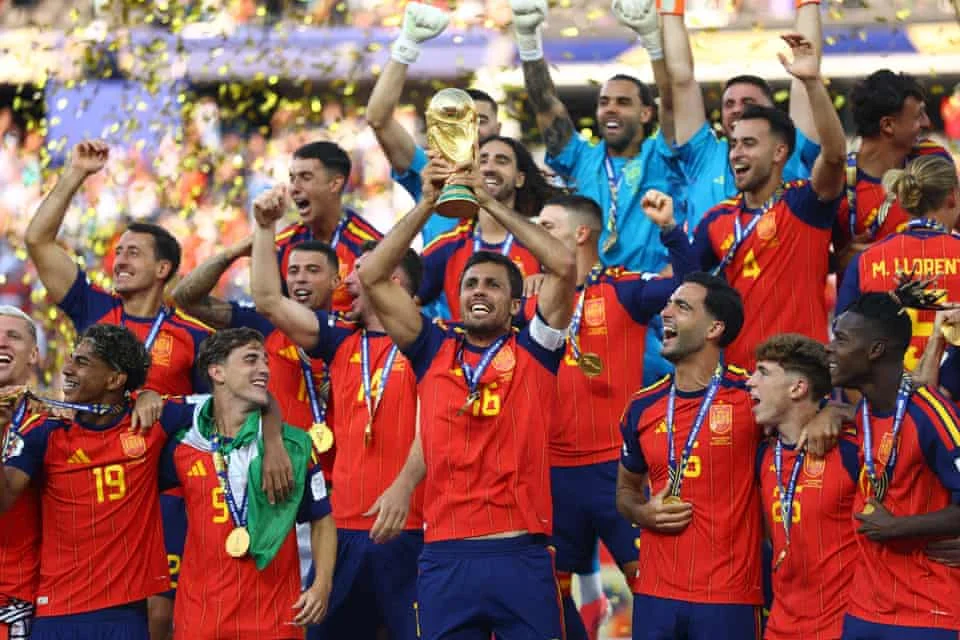
Spain’s 1-0 extra-time victory over Argentina brought the 2026 FIFA World Cup to a dramatic conclusion in New Jersey.
Ferran Torres settled a tense final in the 106th minute, converting Nico Williams’ decisive assist to deliver Spain their second world title.
The victory came 16 years after Spain’s breakthrough triumph in South Africa, confirming a new generation’s arrival on football’s biggest stage.
Argentina’s defeat ended Lionel Messi’s final World Cup appearance without another global title, in spite of his remarkable longevity and enduring influence.
Spain controlled the final for long periods, restricting Argentina to a single shot while creating the clearer opportunities.
The match became increasingly fractious, with Enzo Fernández sent off after receiving a second yellow card late in the contest.
Argentina’s defensive tactics, repeated stoppages and late confrontations intensified debate over sportsmanship, discipline and officiating.
Torres’ decisive strike provided the defining image of a tournament that repeatedly challenged football’s established order.
The 2026 World Cup represented football’s biggest structural expansion, featuring 48 teams, 104 matches and three host nations.
The U.S., Canada and Mexico transformed the tournament into a vast continental spectacle combining football, entertainment and commercial ambition.
The expanded format created opportunities for emerging football nations while intensifying concerns about player workload, travel demands and tournament length.
By the end, the competition had produced record participation, huge global engagement and a succession of unexpected footballing stories.
The tournament produced 305 goals across 104 matches, setting a new scoring record for a single World Cup.
Spain emerged as the tournament’s defining footballing force, combining possession, technical control and positional intelligence throughout their campaign.
Their 2-0 semi-final victory over France demonstrated their ability to control elite opposition without abandoning attacking ambition.
Against Argentina, Spain again dictated the rhythm, dominating possession and producing the overwhelming majority of the match’s attacking opportunities.
That dominance ultimately produced the decisive moment, with Torres becoming the unlikely hero of the tournament’s defining match.
Spain’s triumph, therefore, represented more than a victory; it confirmed the continuing evolution of their technical footballing identity.
Rodri, Spain’s midfield leader, was named the tournament’s best player and received the Golden Ball.
His recognition reflected the importance of control, intelligence and tactical influence beyond goals and assists.
Unai Simón won the Golden Glove after playing a central role in Spain’s defensive excellence.
Pau Cubarsí claimed the Young Player Award after a remarkably composed campaign at the heart of Spain’s defence.
Spain, therefore, collected the Golden Ball, Golden Glove and Young Player Award, underlining their extraordinary individual and collective dominance.
Kylian Mbappé won the Golden Boot after finishing the tournament with 10 goals for France.
The French captain’s campaign further cemented his status as one of the defining attacking figures of his generation.
Mbappé’s achievement became even more significant after he had already won the Golden Boot at Qatar 2022.
Messi’s campaign carried enormous emotional weight, with the 2026 tournament widely regarded as his final World Cup.
The Argentine captain remained one of the competition’s biggest attractions, combining extraordinary longevity with another outstanding scoring campaign.
His final appearance against Spain, however, proved unusually difficult as Argentina struggled to create meaningful attacking opportunities.
Messi’s final chapter ended without another trophy, but his legacy was strengthened by longevity, competitiveness and unmatched consistency.
The African campaign provided one of the tournament’s most compelling collective stories, with 10 representatives carrying the continent’s hopes.
Nine African teams reached the Round of 32, a record achievement that demonstrated the continent’s growing competitiveness.
CAF President Patrice Motsepe congratulated the nine survivors, calling their qualification “hard-earned and well-deserved”.
The achievement represented the first time that 90 per cent of Africa’s World Cup representatives reached the knockout stage.
Morocco again led Africa’s challenge, reaching the quarter-finals before losing 2-0 to France.
Their run confirmed that the 2022 semi-final was no isolated achievement, with Morocco again displaying organisation and tactical discipline.
The Atlas Lions’ progress reflected a broader transformation in African football, built on stronger development structures and improved tactical sophistication.
Cape Verde provided arguably the tournament’s most remarkable African story, reaching the Round of 32 on their World Cup debut.
Their campaign transformed the expanded tournament into a genuine platform for emerging football nations.
Cape Verde’s progress became one of the competition’s most compelling underdog narratives, particularly after impressive performances against established opposition.
Their achievement demonstrated how expansion could create meaningful opportunities for countries previously excluded from football’s biggest stage.
Egypt also enjoyed a notable campaign, reaching the Round of 16 before losing 3-2 to Argentina.
The Pharaohs showed technical quality and resilience, although their elimination underlined the narrow margins separating progress from disappointment.
Algeria reached the Round of 32 before losing 2-0 to Switzerland in a campaign showcasing their technical ambition.
Ghana also reached the knockout phase before suffering a narrow 1-0 defeat to Colombia.
Côte d’Ivoire exited after a 2-1 defeat by Norway, in spite of showing athleticism and attacking quality throughout their campaign.
The Democratic Republic of Congo were beaten 2-1 by England after reaching the knockout phase during their historic campaign.
Senegal’s campaign ended with a 3-2 extra-time defeat to Belgium after the West Africans again demonstrated their competitiveness.
South Africa lost 1-0 to Canada in the Round of 32 after becoming one of Africa’s nine knockout-stage representatives.
Tunisia were the only African team eliminated during the group stage, ending a campaign against an exceptionally demanding field.
Together, the 10 African representatives made the 2026 World Cup a landmark moment for the continent.
While Morocco delivered the deepest run, Egypt reached the Round of 16 and eight other African teams reached the knockout phase.
The performances strengthened arguments for greater investment, stronger domestic structures and improved pathways from youth development to elite football.
Nigeria’s absence was itself a significant storyline, given the country’s rich World Cup history and status as an African football powerhouse.
The Super Eagles failed to qualify, missing a tournament where Africa achieved its strongest collective performance in World Cup history.
Their absence demonstrated that expanded qualification opportunities have not eliminated the intense competition within African football.
The tournament also produced remarkable performances from outside the traditional footballing hierarchy.
Norway delivered one of the competition’s most impressive campaigns before exiting in the quarter-finals.
Erling Haaland provided a devastating attacking threat, while Norway’s victory over Brazil became one of the tournament’s major shocks.
Brazil’s defeat by Norway in the Round of 16 represented one of the competition’s major disappointments.
The five-time champions entered the tournament with enormous expectations but failed to reach the latter stages.
Their early departure reinforced the growing unpredictability of international football.
England secured third place after a remarkable 6-4 victory over France in an extraordinary bronze-medal match.
The result provided spectacular entertainment but exposed England’s defensive weaknesses during a tournament of enormous expectations.
Their campaign nevertheless represented a significant achievement, with England reaching the semi-finals before losing narrowly to Argentina.
France, in spite of Mbappé’s record-breaking individual campaign, were unable to convert their attacking brilliance into a place in the final.
Their defeat to Spain in the semi-finals and subsequent loss to England created one of the tournament’s most dramatic conclusions.
The semi-final line-up featured Spain, France, England and Argentina, four of international football’s most recognisable powers.
The line-up reflected the continuing strength of traditional footballing nations after an expanded group stage created opportunities for outsiders.
It also ensured that the decisive matches featured some of the sport’s most recognisable footballing brands.
Technology remained one of the tournament’s most contentious themes.
VAR decisions, high-tech match balls and increasingly data-driven officiating generated criticism from players, coaches and supporters.
The debate centred on whether technology was improving accuracy or making football increasingly difficult to understand.
The tournament therefore reinforced a continuing football dilemma: how far should technology intervene in a sport built around human judgement?
Hydration breaks became another source of debate during the competition.
Although introduced to protect players from extreme conditions, interruptions affected match rhythm and generated criticism from some supporters.
The issue reflected growing tension between football’s expanding calendar and increasingly demanding environmental conditions.
The tournament again raised questions about whether elite football can continue expanding without compromising player welfare.
Ticket prices also attracted criticism in spite of packed stadiums and enormous global demand.
The tournament demonstrated extraordinary popularity while exposing the widening gap between football’s global appeal and affordability.
That tension is likely to remain central to debates surrounding future FIFA tournaments.
The competition also unfolded against a complicated international political backdrop.
Iran’s participation generated debate amid continuing Middle Eastern tensions, while political interference concerns attracted attention around disciplinary matters.
The controversies demonstrated once again that the World Cup cannot be separated entirely from the geopolitical environment surrounding it.
Football’s global reach ensures that every tournament becomes both a sporting event and an international political stage.
The North American setting produced an unprecedented combination of football, entertainment and commercial spectacle.
Major cities hosted matches while celebrities, politicians and corporate interests competed for attention alongside the football itself.
The tournament’s entertainment dimension reinforced the World Cup’s transformation into one of the world’s largest global spectacles.
The 48-team tournament became the largest World Cup ever staged, featuring 104 matches across six weeks.
Messi became the oldest player to score a World Cup hat-trick, extending his extraordinary record of tournament achievements.
Cristiano Ronaldo became the first player to score at six different World Cups, creating another landmark in football history.
Mbappé strengthened his status as the tournament’s all-time leading scorer and added another Golden Boot to his collection.
Dick Advocaat became the oldest coach to manage at a World Cup, aged 78.
Cape Verde’s knockout qualification established one of the competition’s most extraordinary national milestones.
The tournament’s principal honours reflected its varied themes and celebrated excellence across several dimensions of football.
Rodri won the Golden Ball, Mbappé the Golden Boot, Simón the Golden Glove and Cubarsí the Young Player Award.
The Netherlands won the FIFA Fair Play Trophy, completing the tournament’s principal honours.
The awards recognised technical brilliance, goalscoring, goalkeeping, youth development and sporting conduct.
The 2026 World Cup succeeded because it combined the familiar with the unexpected.
Traditional powers dominated the final stages, but emerging nations created some of the tournament’s most memorable narratives.
African teams demonstrated that the continent’s footballing influence is expanding beyond occasional moments of surprise.
Morocco’s quarter-final run and Cape Verde’s historic debut provided powerful evidence of that widening competitive landscape.
The competition expanded football’s geographical reach while simultaneously exposing the costs of expansion.
It celebrated technological progress while generating fresh arguments about technology’s role.
It delivered spectacular entertainment while raising serious questions about affordability, politics and player welfare.
Ultimately, Spain’s victory gave the tournament its most fitting ending.
A technically sophisticated team defeated a defending champion built around experience, resilience and one of football’s greatest-ever players.
Torres’ extra-time goal provided the decisive image of a competition filled with unexpected heroes.
The final therefore belonged to Spain, but the tournament belonged to a changing football world.
The 2026 World Cup showed that football’s traditional hierarchy remains powerful, but no longer feels entirely secure.
For six weeks, the sport expanded its borders, created new heroes and generated fresh controversies.
When the final whistle sounded, Spain stood alone as champions.
Yet the tournament’s lasting legacy may be evidence that football’s future is broader, younger, more technological and increasingly unpredictable. (NANFeatures) (www.nannews.ng)
Edited by Vivian Ihechu
***If used, kindly credit the writer and the News Agency of Nigeria (NAN