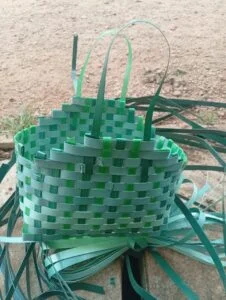
Two orphaned brothers, Ibrahim Auwal 14 and Kamal Ibrahim 15 are turning plastic bale straps which used to be discarded to earn a living and support their household in Kaduna.
Through skill, patience and determination, the brothers transform the strap used to tie imported clothing bales into colourful handwoven baskets that generate income for their family.
The brothers, both students in Junior Secondary School (JSS) 2, live with their grandfather in Rigasa area, following the death of their biological father, while their mother has remarried.
“I just stood there and watched them because we lived in the same area. That was how I learned,” he said.
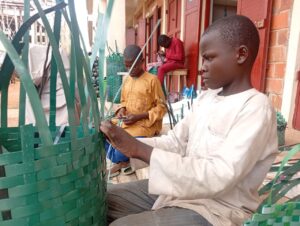
The teenager said he started experimenting with the craft while in primary five and gradually improved through practice.
According to him, his determination to earn an income intensified when he was asked to pay examination fees at school.
Although his grandfather later provided the money, Ibrahim said the incident motivated him to take the trade more seriously.
“I took some materials that had been brought to me, made a basket and went to sell it at Yan Gwari market. I made N3,200 that day and gave the money to my mother,” he recalled.
Since then, he has continued producing and selling miniature baskets, earning an average profit of about N5,000 whenever he sells 10 pieces.
He explained that materials worth N1,000 could produce baskets worth about N3,000, while a small basket made from materials costing N200 could sell for N500.
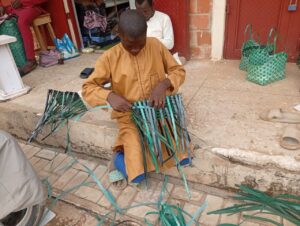
He said he usually spends Thursdays and Fridays weaving, while Wednesdays and Saturdays are reserved for marketing his products.
“In a good week, I can make up to N10,000 profit, though sometimes it is less,” he said.
His elder brother, Kamal said he joined the trade after seeing Ibrahim earn money from it.
“It was my younger brother who taught me. I saw he was making money, and our grandmother encouraged me to learn too,” Kamal said.
Kamal explained that he learned the skill while in primary school and has continued practicing it alongside his studies.
When asked whether the trade affected their education, they said it does not.
Like his brother, Kamal contributes part of his earnings to the family’s upkeep.
He said the money helps him buy clothes and personal items, while some of it goes toward household expenses.
Ibrahim said he often gives between N1,000 and N3,000 to support the household whenever he returns from the market after making sales.
The young entrepreneurs, however, face challenges.
Both cited loss of money during business trips as one of their recurring setbacks.
Kamal admitted that he had on several occasions misplaced earnings after sales, partly because he carried the money in worn-out pockets.
Yet, neither brother appears discouraged.
While Kamal hopes to learn additional vocational skills in the future, Ibrahim wants to expand the basket-weaving business.
Their immediate needs, he said, are access to capital and a secure workspace.
“We need capital support and a place where we can work, like a shop. We can keep our materials there and continue our work without worrying about where to store them,” Ibrahim said.
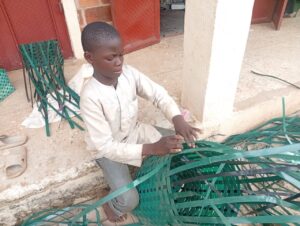
Abdullahi Yunusa, a second hand clothes seller who sells these plastic straps to the boys said he appreciates how they prefer buying rubber to create a basket instead of doing nothing and playing football in the neighborhood.
“Anytime they get money, no matter how small,they prefer buying the rubber to create baskets, it is a really big achievement.
“Instead of waiting for their parents to do something for them, with this creativity, they can take care of themselves and even help their parents,” he said.
Yunusa added that the plastic straps used to be a waste that was usually thrown away in the past due to lack of knowledge on how to recycle it.
According to him, young persons started using them to make baskets in 2021, adding that the product has now reached other states like Kano where youths buy them for dumping waste, while mothers buy the small ones for their children in school.