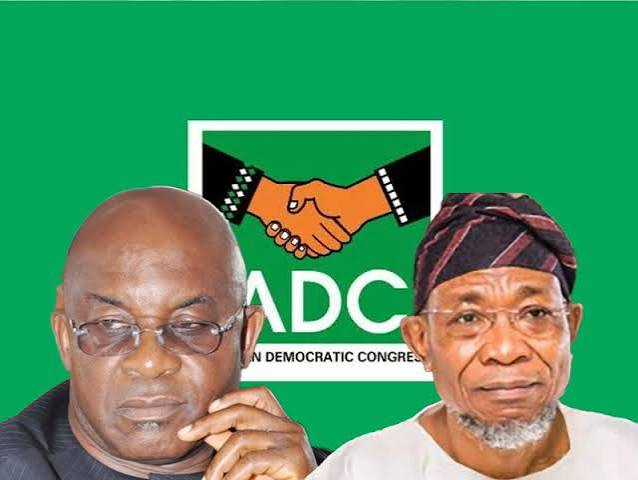
The Court of Appeal sitting in Abuja on Monday affirmed a Federal High Court judgment restraining the Independent National Electoral Commission (INEC) from recognising state congresses conducted by committees appointed by the caretaker leadership of the African Democratic Congress (ADC) headed by former Senate President, David Mark.
In a majority decision delivered by Justice Okon Abang, the three-member appellate panel held that there was no basis to overturn the April 29 ruling of the Federal High Court, which barred the Mark-led leadership from organising state congresses through committees appointed by the national caretaker structure.
The appellate court also upheld the order of Justice Joyce Abdulmalik restraining the caretaker leadership from interfering with the tenure and functions of the ADC’s duly elected state executive committees. The court agreed with the lower court that the responsibility for conducting state congresses lies with the elected state executive committees rather than the national leadership of the party.
Justices Okon Abang and Donatus Okorowo constituted the majority that upheld the lower court’s orders and directed that INEC should not recognise the outcomes of congresses conducted under the authority of the Mark-led leadership.
However, the presiding Justice of the panel, Justice Abba Mohammed, dissented. In his minority judgment, he held that the dispute arose from the internal affairs of a political party and was therefore non-justiciable. According to him, the Federal High Court lacked jurisdiction to entertain the suit in the first place.
The ruling could have significant political implications, particularly for former Vice President Atiku Abubakar and other aspirants whose candidacies reportedly emerged from congresses organised by the Mark-led faction of the ADC in preparation for the 2027 general elections.
The Federal High Court had earlier ruled that the four-year tenure of the ADC’s State Working Committees and State Executive Committees remained valid and subsisting pending the conduct of properly constituted congresses and the convening of a national convention.
The suit, marked FHC/ABJ/CS/581/2026, was instituted by Don Obinna, Johnny Derek, Obah C. Ehigiator, Olona Yinka, Dr. Charles Omideji, Samuel Gyang and Obianyo Patrick on behalf of all ADC State Chairmen and State Executive Committees.
Named as defendants in the action were the ADC, Senator David Mark, Senator Patricia Akwashiki, Bolaji Abdullahi, Rauf Aregbesola, Professor Oserheimen Osunbor and INEC.
The plaintiffs challenged the decision of the caretaker leadership to establish committees for the conduct of state congresses, arguing that such appointments were unconstitutional and contrary to the provisions of the ADC Constitution. They contended that only duly elected organs of the party possess the authority to conduct congresses and that any congresses supervised by the caretaker committee would amount to a violation of the party’s governing framework.
In affirming the lower court’s decision, the Court of Appeal stated that judicial intervention was necessary to “prevent anarchy and ensure the survival of democracy in Nigeria.” The court relied on a recent Supreme Court decision arising from the leadership crisis within the Peoples Democratic Party (PDP) and held that the ADC dispute could not be dismissed as a mere internal party matter.
Justice Abang observed that where allegations involve breaches of constitutional provisions, the doctrine shielding political parties from judicial scrutiny ceases to apply.
“Once a complaint before the court is anchored on a constitutional infraction, the shield of internal affairs drops and the veil is lifted for judicial intervention,” he stated.
Consequently, the court dismissed Appeal No. CA/ABJ/CV/608/2026, filed by the ADC seeking to set aside the judgment of the Federal High Court.
In her April 29 judgment, Justice Abdulmalik had held that neither the Constitution of the Federal Republic of Nigeria, 1999 (as amended), nor the ADC Constitution vested the caretaker National Working Committee with the authority to appoint committees for the purpose of conducting state congresses.
She further ruled that the claims raised by the plaintiffs disclosed constitutional and statutory violations warranting judicial consideration. The court also noted that Section 223 of the Constitution requires political parties to conduct periodic elections in accordance with democratic principles, while Article 23 of the ADC Constitution stipulates that national and state officers may serve a maximum of two terms spanning eight years.
Edited by Ifeoluwa Oluseye.